
Debunking the claims made by Mark Hall of Wild Origins Canada
When cougar hunters killed a female cougar near Canmore, Alberta, last February, allegedly leaving two kittens orphaned, the incident sparked widespread public condemnation. But rather than confronting the ethical implications of the killing, some within the hunting community sought to challenge the account itself, questioning whether the dead cougar was actually the kittens' mother. It was a revealing response to an already troubling incident—and another example of how quickly the debate over trophy hunting can shift from the welfare of wildlife to defending the practice itself.
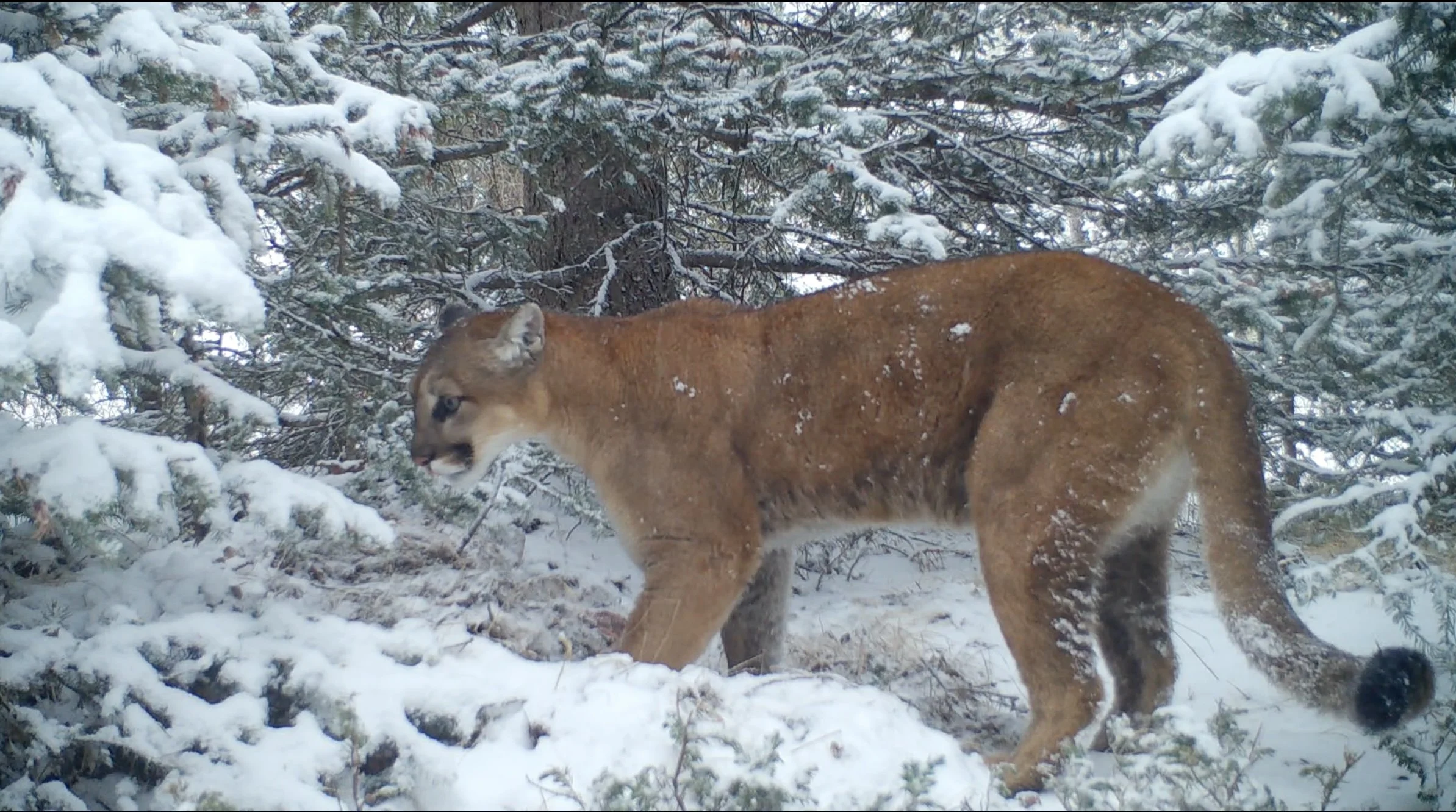
Cougar in the Canmore region of Alberta
Photograph © John E. Marriott
Wild Origins (formerly Blood Origins), an online trophy hunting publication, posted an article by Mark Hall, Director and co-founder of Wild Origins Canada, entitled, Alberta Cougar Hunting Debate: Is There Any Truth? In the article, Hall disputes the claim that the cougar killed was the mother of the two orphaned kittens as he wrote, “. . . upon closer examination, the evidence supporting this claim appears tenuous and riddled with inconsistencies.” Although Hall insists the claims are ‘riddled with inconsistencies,’ he lists only two which call into question the actual age of the cougar killed and whether it had ever nursed kittens.
Seeking to debunk the assertions made by local conservationist and renowned photographer, John E. Marriott, who broke the story, Hall refers to an un-named expert who determined the cougar to be only three years old. “John E. Marriott, a prominent voice in this debate, claimed to have tracked the cougar for four years,” writes Hall. “Yet, an assessment of the animal’s age using the gum-line recession method revealed the cougar was only three years old, undermining Marriott’s assertion.”
Ignoring the lack of transparency in not naming the expert, this method of age determination for cougars is imprecise. In a 2014 study in the Northwestern Naturalist entitled, Comparison of Two Age-estimation Techniques For Cougars, the authors concluded that due to variables, such as the potential imprecision among observers, “the use of gum-line measurements perhaps should be considered a coarse estimate of age relative to cementum annuli analysis.” The article also details how there could be a discrepancy between live and dead cougars due to drying of the gums after death.
In another attempt to cast doubt on whether the slain cougar was the mother of the orphaned kittens, Hall relies on an unnamed “experienced hunter” and the purported findings of a postmortem examination. He writes, “. . . the female cougar was judged by an experienced hunter not to be nursing or bearing kittens, a conclusion supported by postmortem examination of her teats. Furthermore, evidence suggests the cougar had never reproduced, aligning with her estimated age of three years.”
But what, exactly, is this evidence? Hall does not identify the hunter, establish their qualifications, name the individual who conducted the postmortem examination, or provide documentation of its findings. Without that information, readers have no meaningful way to assess the reliability of these claims. Nor does an estimated age of three years establish that the cougar had never reproduced. Female cougars can reach reproductive maturity at approximately two years of age, making Hall's inference particularly questionable. And while an examination of the animal's mammary tissue might provide useful evidence about recent nursing activity, it would not necessarily establish whether she had ever given birth. The distinction is important. Hall presents numereous assertions as though they collectively undermine the possibility that this cougar was the kittens' mother. Yet without independently verifiable findings, those assertions remain unconfirmed—not proof that Marriott's account is not accurate.
After having been live trapped, the orphaned cougar kittens were transported to the Calgary Zoo as it was determined their chances for survival in the wild were minimal. A statement from the zoo reads, “These little ones lost their mother and, at approximately 5–6 months old, wouldn’t have survived on their own.”
Unsurprisingly Hall, citing yet another un-named source, made the assertion that these kittens were old enough to have been able to survive on their own. “In my opinion, these kittens should have been given the benefit of the doubt and left in the wild,” insists Hall. “As one cougar expert reported to me that they were living in an incredibly prey rich environment especially rich in small prey that can easily be caught by a young cougar.”
Hall also cited research suggesting that orphaned cougar kittens older than six months have a 71 per cent chance of surviving to adulthood. What he failed to mention, however, is that the very same document from Montana Fish, Wildlife & Parks reports a dramatically different survival rate for younger kittens. According to the agency's Mountain Lion Identification Course, orphaned kittens younger than six months have just a four per cent chance of surviving to adulthood, compared with 71 per cent for those older than six months. That distinction is hardly insignificant. The Canmore kittens were estimated to be approximately five to six months old, placing them at or near the very age threshold separating these dramatically different survival outcomes. While their precise ages cannot be established from those estimates alone, citing the more favourable statistic without acknowledging the substantially poorer prospects for younger kittens presents an incomplete and potentially misleading picture. The question is not whether some orphaned cougar kittens survive without their mothers. Clearly, some do. The question is whether leaving these particular kittens in the wild would have been a reasonable gamble with their lives.
Cougar kittens remain dependent on their mothers for considerably longer than the five to six months these kittens had been alive. According to The Cougar Fund, a nonprofit organization advocating for science-based cougar management, “Cougar kittens stay with their mothers anywhere from 18 to 24 months. It is in this time that kittens learn proper prey identification and hunting skills.” That prolonged period of maternal care is critical to their development. While young cougars may begin eating solid food and accompanying their mothers on hunts well before becoming independent, doing so is not the same as possessing the skills necessary to survive alone. Given the kittens' estimated ages and the survival statistics already discussed, Hall's suggestion that they should have been left in the wild raises a serious question: was the possibility of survival sufficient justification for exposing them to such considerable risk?
Much has been made of whether the orphaned cougar kittens had visible spots, a distinction with important implications under Alberta's hunting regulations. John E. Marriott has maintained that he observed spots on both kittens, an observation subsequently confirmed by provincial authorities. In an article published in the Rocky Mountain Outlook, staff writer Cathy Ellis reported that Alberta's Ministry of Public Safety and Emergency Services, which oversees Fish and Wildlife, confirmed the kittens did have spots. Yet, officials concluded there was insufficient evidence to lay charges, stating that the circumstances “did not meet the threshold for an unlawful hunt.” That conclusion raises questions in need of further explanation. If the kittens had visible spots, what prevented investigators from establishing that the hunt violated the applicable regulations? Was the difficulty proving that the dead cougar was their mother, establishing what the hunters knew or reasonably could have known, or was there some other legal requirement not met? Without a fulsome explanation of the investigative findings, the public is left with an unresolved contradiction: confirmation of a circumstance constituting a wildlife violation, but no resulting charges.
Hall was quick to point to the investigation's outcome in an email responding to my questions about his reliance on unnamed sources. In his reply, he also referred to his political connections, writing:
I was personally briefed by Premier Danielle Smith on what I learned from the individuals and that has satisfied the Premiers office that nothing nefarious happened, so I think that's case closed for the government now.
That is a bold assertion, but it raises more questions than it answers. Hall's account of a briefing involving the premier does not, by itself, establish what evidence investigators considered, how they evaluated it, or why they determined that charges were unwarranted. Nor does it resolve the uncertainty surrounding the identity of the cougar killed. As for his refusal to identify the experts on whom his article relies, Hall maintained that anonymity was necessary because of potential threats to their well-being. Protecting sources from credible threats is a legitimate journalistic consideration. But anonymity also places a greater responsibility on the writer to establish why those sources should be considered authoritative and how their claims have been corroborated. In this case, readers are asked to accept conclusions about the cougar's age, reproductive history and identity without knowing the qualifications of those making the assessments or having access to the underlying findings. That is a glaring evidentiary gap, particularly when those conclusions are being used to challenge the account of an identifiable conservationist, who does not hide behind anonymity.
Hall also argued that cougar mothers often leave their kittens for extended periods, suggesting that the cougar killed may not have been the mother of the orphaned kittens. However, this explanation fails to adequately address the subsequent events. The female cougar was killed on February 10, and by February 13, Alberta Fish and Wildlife was reportedly planning to capture the kittens. A subsequent report in the Rocky Mountain Outlook explicitly identified the killed cougar as their mother. While Hall raised alternative possibilities, his argument relied on uncertainty about the mother's identity rather than evidence establishing that another female cougar was responsible for the kittens. The question is not whether cougar mothers sometimes leave their young unattended. They do. The question is whether the available evidence supports Hall's alternative explanation in this particular case.
Ironically, Hall's own argument highlights a major weakness in the regulations intended to protect dependent cougar kittens. If female cougars routinely leave their offspring unattended while hunting, the absence of kittens nearby cannot reliably establish that a female has no dependent kittens. This raises an important question: should hunting regulations provide better protection for female cougars rather than relying on hunters’ judgment when they may be lacking the full picture to make that judgment?
The Cougar Fund, a nonprofit organization advocating for science-based cougar management, highlights the potential consequences of orphaning dependent kittens:
If hunters are not selective and able to properly identify the sex of a cat, there is a high potential to orphan kittens. These kittens often end up starving to death or dying from exposure. Those that do survive often get into trouble. Not having proper prey identification skills and lacking the necessary hunting skills, these young cats may end up preying on easy targets such as livestock or pets.
Those factors must be taken into consideration for wildlife regulators because if orphaned kittens are more likely to have difficulty hunting wild prey and may subsequently target livestock or pets, preventing the orphaning of kittens could potentially reduce depredation and human–cougar conflicts. Again, Hall's argument that mothers often leave their kittens for prolonged periods therefore begs the question his article does not address: why shouldn't Alberta implement stronger protections for female cougars when the consequences of ‘mistakenly’ killing a mother extends far beyond the loss of a single animal?
In another attempt to challenge Marriott's account, Hall disputes the existence of cougar bounties in Alberta. Yet the Wild Sheep Foundation’s (WSF) own payment schedule tells a different story. In a February 27, 2025 article in the Rocky Mountain Outlook, Cathy Ellis reported that the foundation's 2024–25 cougar program offered payments of up to $3,000 for a cougar killed, with an additional $1,000 for a female. Ellis also reported that payments could reach $7,000 in designated wildlife management units, including WMU 410 in the Bow Valley. These financial incentives raise serious questions about the foundation's approach to predator management. Paying hunters more money to kill female cougars highlights an obvious concern: if those females have kittens, killing them could leave their young orphaned and unlikely to survive, which may well be the point. The program also illustrates how financial incentives can become entangled with wildlife management decisions, especially when predator reduction benefits populations of desirable ungulate species.
Hall, however, draws a distinction between the existence of such payments and whether compensation was provided for the cougar killed near Canmore. He wrote, “Interviews with the presidents of the Wild Sheep Foundation and its Alberta chapter confirmed no financial compensation was provided for this hunt.” Even if that claim is true, it does not negate the existence of the foundation’s cougar payment program. Hall also neglected to provide evidence determining whether the killing of this cougar was eligible for compensation, whether an application was submitted, or why no payment was made. This distinction matters because a payment program creates financial incentives for killing cougars regardless of whether compensation is paid in every individual case.
Marriott has been unambiguous in his criticism, stating, “Cougars should not be getting slaughtered in our province and our valley because of a WSF bounty. It's both disgraceful and despicable.”
The foundation's own application forms provide readers with an opportunity to examine the payment provisions for themselves.
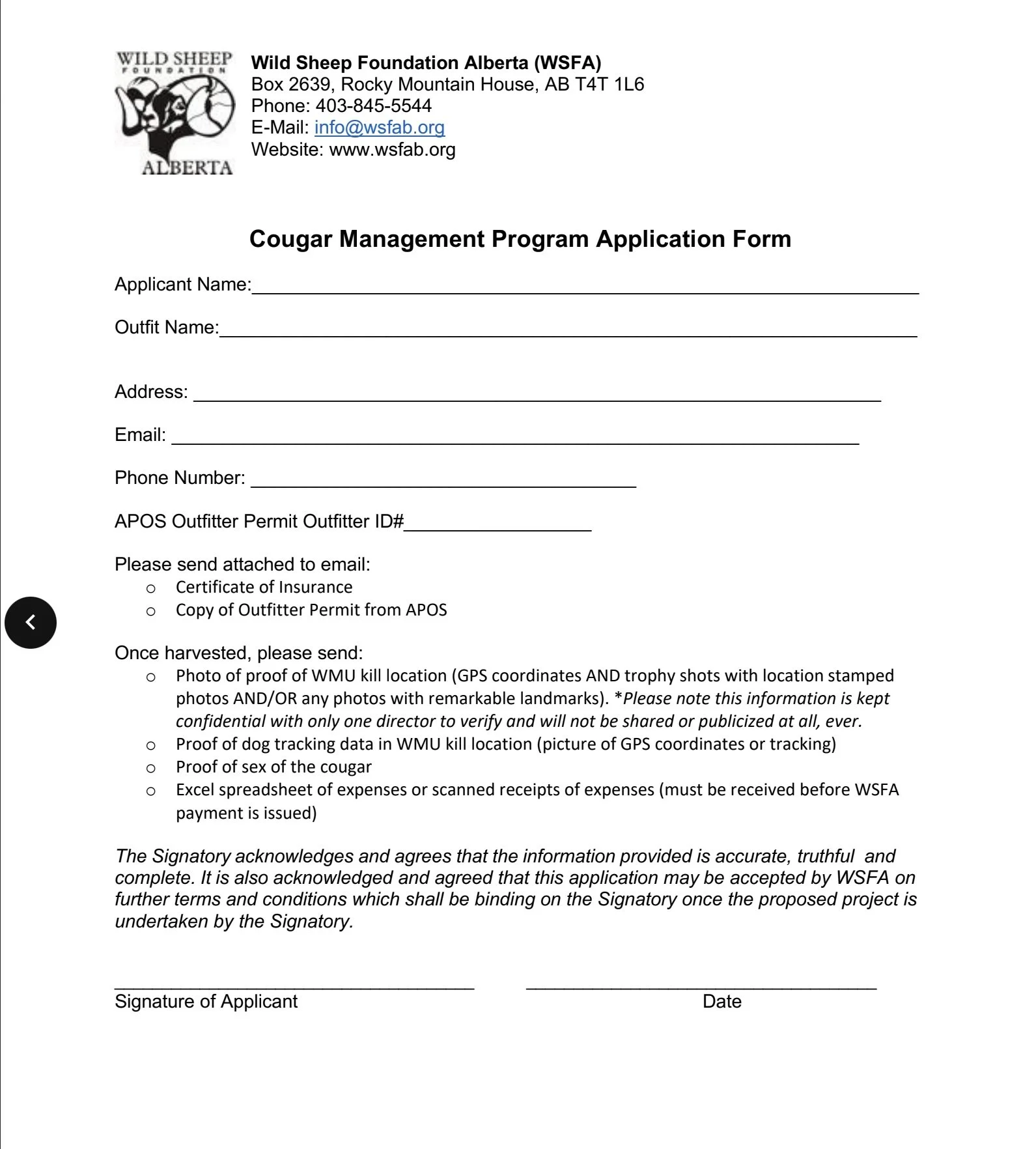
Wild Sheep Foundation Alberta's 2024–25 Cougar Management Program application form, outlining the information required to apply for payment following a cougar hunt.

WSF Alberta's 2024–25 Cougar Program Requirements, detailing payments of up to $3,000 per cougar, including additional incentives for female cougars in certain categories, and higher payments in designated wildlife management units.
Earlier in his article, Hall cites a scientific review that appears to challenge Marriott's claim that cougar hunting can lead to more conflicts with people. But the review doesn't actually rule out that possibility. Published in 2022 by the Washington Department of Fish and Wildlife, the review examined several studies looking at whether killing cougars increases or reduces conflicts with humans. The findings were mixed. Some studies linked increased hunting to more conflicts, while others suggested the opposite. The researchers also raised concerns with how many of the studies were conducted, making their conclusions less reliable. They recommended better research methods to determine what effect cougar hunting actually has on conflicts with people. In other words, the review does not prove that hunting increases conflicts. But it certainly doesn't prove that hunting reduces them, either.
The Mountain Lion Foundation offers another perspective arguing that killing established adult cougars can leave their territories open to younger, less experienced animals that may be more likely to come into conflict with people, livestock and pets:
Killing a mountain lion doesn’t mean that there is one less lion with which to have conflict. It simply means there is an empty territory for other, younger and less experienced mountain lions to fill.
While more research is needed, it still raises the question: could killing cougars sometimes create the very problems that hunting is supposed to prevent?
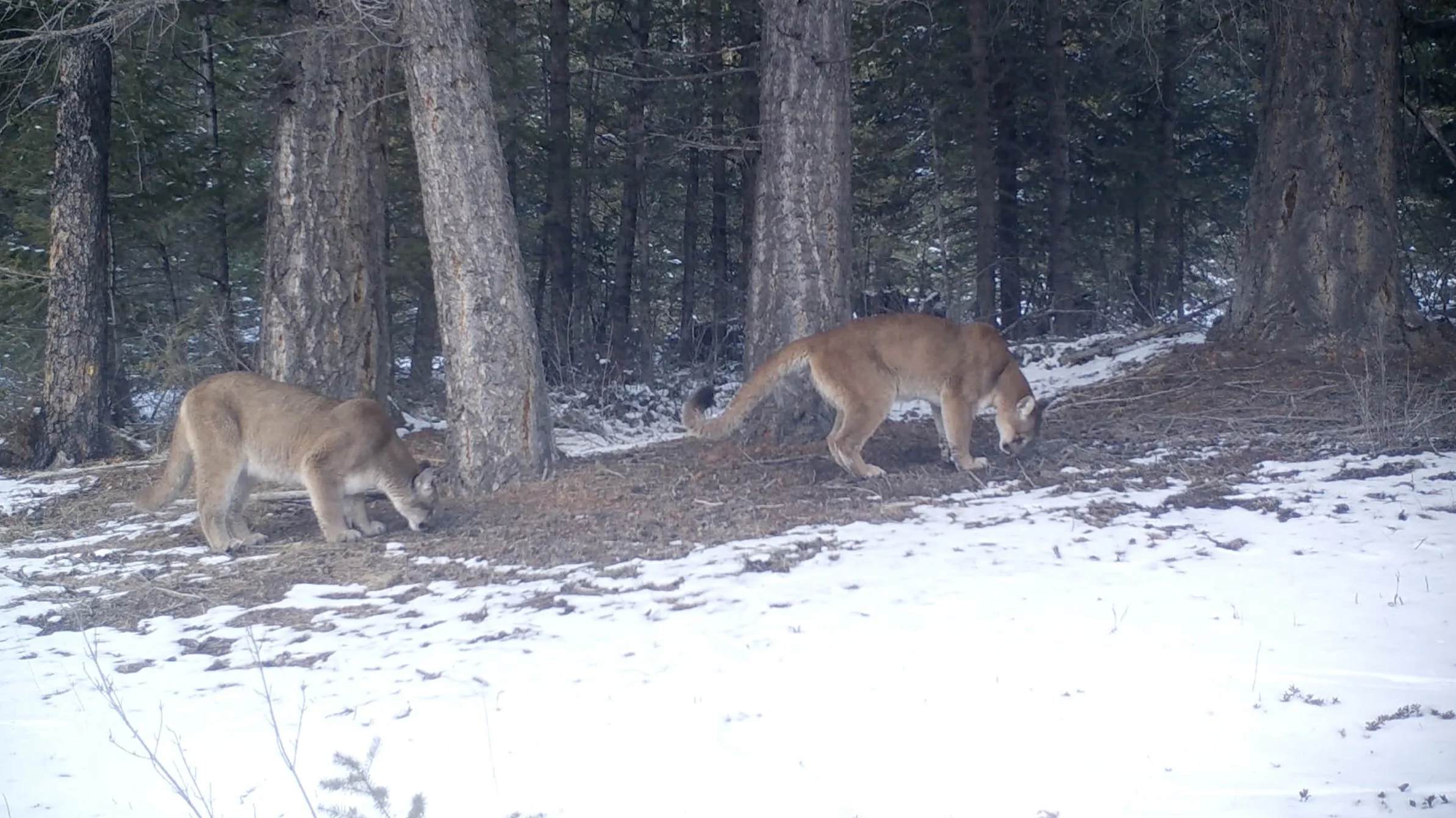
Adolescent cougars exploring their surroundings
Photograph © John E Marriott
Hall also praises Alberta's history of cougar management, suggesting that political interests have played no role in management decision making, declaring:
The broader context of cougar conservation in Alberta reveals a progressive history of sustainable management practices. Fluctuations in cougar mortality rates are influenced by natural variables and government policies, with no political party demonstrating a vested interest in unsustainable practices.
But Hall's claim requires a closer look. Todd Loewen, Alberta's Minister of Forestry and Parks, owned and operated a hunting guide/outfitting business before taking office. While that background does not, by itself, establish undue influence, it certainly raises questions about whose interests are being served when hunting regulations are changed. Those questions are gaining traction, in large part, due to a June 2025 investigation published in the The Narwhal that was based on internal government records. The documents revealed Alberta's expanded cougar hunting opportunities were crafted through direction from the minister with input from hunting groups, and most importantly, without having conducted a new assessment of the province's cougar population. This does not prove that Alberta's cougar management is unsustainable, but it certainly challenges Hall's broad assurance that political interests have played no meaningful role. If Alberta's wildlife management decisions are truly guided by science rather than political or industrial interests, the government should be able to reveal to the public the evidence behind those decisions. Transparency would put to rest any thoughts of impropriety one way or the other.
“We’ve got a problem here in Alberta; we’ve got a minister who just really wants to go out and kill all of our wildlife”
Consider the recent policy initiatives implemented by Todd Loewen, Minister of Forestry and Parks. Since taking over the portfolio, Minister Loewen implemented new cougar hunting regulations expanding hunting areas, increasing quotas, and making changes to how dogs can be used for hunting. He added new cougar management areas (CMA’s), which included Cypress Hills Provincial Park and its surrounding areas, to allow harvesting in these previously hunting-free zones where cougar populations are deemed to be at risk. Minister Loewen, not only increased quotas for cougar harvests in general, but he also inexplicably increased the number of female cougars that can be hunted and killed. He even expanded how and where hounds can be used for cougar hunting, allowing off-leash tracking in various provincial parks and recreation areas, as long as they are under the control of their handler and are outfitted with GPS trackers. Every single regulatory change Minister Loewen has made removed barriers to hunting cougars that had been originally implemented to protect them from over-harvesting.
Sarah Elmeligi, a wildlife biologist as well as NDP MLA for Banff-Kananaskis, was quoted in The Rocky Mountain Outlook article mentioned earlier, stating, “We’ve got a problem here in Alberta; we’ve got a minister who just really wants to go out and kill all of our wildlife.”
Yet, Hall continues to heap praise on the Alberta government’s current and historical cougar management strategies declaring, “Alberta’s approach to cougar conservation has incrementally improved cougar abundance and distribution over the past century, ensuring their populations remain stable despite modest hunting activities.” But according to Alberta's own cougar hunting regulations, the original province-wide quota for the 2023–24 season was 32 female cougars. The government subsequently increased that number to 72—a staggering 125 per cent increase in the number of female cougars hunters were permitted to kill. This would most certainly increase the odds of having more orphaned kittens having to fend for themselves.
Hall's praise for Alberta's cougar management stands in sharp contrast to evidence uncovered by journalists and concerns raised by wildlife scientists. In a June 16, 2025 investigation published by The Narwahl, reporter Drew Anderson obtained internal Alberta government documents obtained through freedom-of-information requests. Those records revealed that the decision to expand cougar hunting was directed by the minister and influenced by hunting-industry representatives. According to those documents, the groups consulted included the Alberta Professional Outfitters Society and the Alberta Tree Hounds Association. The records also revealed that statistical information about cougar populations seemed to play no role in the decision to increase quotas.
Marco Festa-Bianchet, a retired professor of animal ecology at the University of Sherbrooke, criticized the government's approach, questioning why years of wildlife research appeared to have been ignored in favour of expanding hunting opportunities. “To me, as a scientist, what’s really bad about it is just, well, let’s just ignore years and years of research and wildlife biology and just say, ‘Potentially cougars are bad, let’s shoot some more.’ ” Festa-Bianchet goes on to explain, “It’s just the whole approach. It’s the same with mountain goats and grizzly bears: just, like, who cares about the science?”
Wildlife scientist Dr. Gilbert Proulx raised similar concerns in an editorial published in Canadian Wildlife Biology & Management, entitled Bad Political Policies Affect Carnivore Conservation and Management. Proulx criticized the expansion of cougar hunting quotas and changes that allow hunting dogs in protected areas without what he considered adequate scientific evidence. And his wider message was clear: wildlife management should be led by qualified wildlife professionals, guided by research and immune to pressure from political and industry interests.
In a rebuke of Minister Loewen’s wildlife policy changes Proulx explained:
Understanding the biology of species and developing programs guided by science demands that conservation programs be developed by field-experienced wildlife professionals who are unswayed by politicians’ agendas and interest groups’ values. Bad political policies affect carnivore conservation and management, and collectively, wildlife biologists, naturalists and environmentalists must work together to end such practices, which endanger species and invalidate years of efforts to ensure the future of wildlife populations and habitats. Meeting political agendas and pleasing special interest groups should not be part of wildlife biologists’ responsibilities, particularly when it is agreed that the maintenance of viable natural wildlife populations always takes precedence over their use by people. Sensible carnivore conservation and management requires professional wildlife biologists who can, when confronted with intimidation from politicians, interest groups and industry, persevere in the implementation of programs aimed at ensuring the persistence of populations and habitats.
I went one step further, contacting Dr. Proulx to ask if he would like to comment on the arguments made by Hall and his response was pointed:
In this particular case, Hall’s opinion is that of a hunter trying to justify his views. In other words, this is a hunter playing “scientist”. There is a difference between evidence generated from scientific research and evidence generated from opinions gathered among his buddies. Asking his friends if hunters killed a cougar with kittens does not result in a science-based conclusion. At best, it is an opinion based on their bias as individuals. I do not put any weight in these statements. Further, when Hall refers to “experts”, he should name these experts and provide the answers to the specific questions that he asked. When he claims that an autopsy confirmed that the animal was 3-years old, I would like to see the pathologist report and the means used to assess the age. Finally, a study of the teats by hunters means nothing to me.
Hall's article asks whether there is any truth to Marriott's account of the female cougar killed near Canmore. But after examining Hall's arguments, I believe the more pressing question is whether his own claims stand up to scrutiny. Throughout his article, Hall relies on unnamed experts, an undocumented postmortem examination and an age estimate based on a method that researchers themselves describe as imprecise. While he questions Marriott's account, he offers little independently verifiable evidence to establish an alternative explanation. Hall concludes by suggesting that the controversy may have brought financial benefit or political gain to some of those involved:
While the story has garnered attention and financial or political gains for some individuals, it is essential to ground public discourse in verified evidence and balanced perspectives.
It's an interesting appeal for verified evidence from someone whose own article relies so heavily on anonymous sources that cannot be verified. And if Hall maintains that Marriott somehow benefited financially or politically from exposing this incident, show that evidence? Otherwise it’s just speculation which surely does not meet the threshold for “verified evidence and balanced perpectives.”
Wild Origins, formerly Blood Origins, has long promoted its mission of “conveying the truth about hunting.” That's a worthwhile goal if the same standards of evidence and transparency apply when the facts are uncomfortable for hunters. The available reporting supports the conclusion that the cougar killed near Canmore was the mother of the two kittens. Provincial authorities also confirmed that the kittens had spots, although investigators determined there was insufficient evidence to lay charges. Those findings deserve careful consideration rather than outright dismissal through speculation about what might have happened instead.
But there is something else missing from this entire debate: the welfare of the animals themselves. In his book The Cougar Conundrum, wildlife biologist Mark Elbroch reminds readers about the sentience and individuality of these animals writing:
Mountain lions feel pain. They exhibit fear and affection, and their family units form close bonds for the duration they remain together. These facts challenge the current approach to wildlife management, which is essentially regulated harvest that prioritizes production over the welfare of individual animals.
That perspective is important. Regardless of one's position on cougar hunting, a female cougar still lost her life, and two young kittens lost the opportunity to grow up and live in the wild. Ironically, their survival became dependent on human intervention, the very species that made them orphans in the first place.
Hall asks readers to question Marriott's credibility. I would ask them to apply the same scrutiny to Hall's claims by examining the sources, considering the evidence and questioning the assumptions. Then ask yourself whether Alberta's approach to cougar management truly prioritizes the welfare of wildlife or whether expanding opportunities to hunt these animals has become the greater priority.
- No lives were taken in the making of this article -
Originally Published June 26, 2025 in Wild & Woke on Substack