
A disturbing look into the minds of trophy hunters
In order to tell this story, I immersed myself in the social media pages of numerous trophy hunters and guide outfitters. I had to steel myself for the task knowing I would be seeing pictures and videos of numerous species of animals that had been, or were in the process of, being killed by these trophy hunters. However, no amount of preparation could have readied me for the graphic images I subjected myself to. Perhaps even more disturbing, was the absolute joy on the faces of the hunters posing with the animals they had killed. And adding to that, was the hateful vitriol directed at me from trophy hunters and their supporters when I dared to post comments opposing this so-called ‘sport.’ To be sure, the comments I made were intentionally provocative in order to elicit angry responses, but it was the nature of the responses that were so alarming. Of note, however, was that among the hundreds of negative comments I personally received, not one came from a woman.

A bighorn ram near the Bull River in the East Kootenays.
Photograph © Jeremy Leete.
Without question, trophy hunting is an inhumane and cruel form of entertainment for people who enjoy killing animals. The idea of trophy hunting being a sport is absurd. I've always believed that sport should involve some reasonable degree of fairness between competitors. But where is the sporting challenge in killing an unsuspecting wild animal with a high-powered rifle, often from hundreds of metres away? The animal isn't competing. It doesn't even know there's a contest. And unlike the hunter, it doesn't get to walk away when things don't go its way. However, this piece is not about the obvious imbalance between hunter and prey; rather, it is an exploration into what character traits are common among those who take up trophy hunting and why they are so well defended against those who oppose this inhumane, yet legal, form of entertainment.
The Psychology of Trophy Hunting
So what is it about posing for a picture with a dead animal or mounting a head on a wall that is so appealing to trophy hunters? Is it about bragging rights and displaying dominance over another creature? Maybe it’s about re-living the adrenaline rush that occurred when taking the animal’s life. Perhaps it’s about a feeling of belonging with like-minded individuals or maybe it’s all of the above. Whatever the reason, the question we should be asking is why.
In psychology, the ‘dark triad’ describes a combination of personality characteristics that include psychopathy (sub-clinical), narcissism (sub-clinical), and Machiavellianism - sub-clinical meaning symptoms or conditions that are present but not severe enough to meet the diagnostic criteria for a specific disorder. Could this combination be what is driving trophy hunters to continually want to kill big-game animals and is this why they are beaming with pride when posing for pictures with the animals they have killed? In a February 3, 2022 article in The Conversation entitled, Psychology of trophy hunting: why some people kill animals for sport, this notion of the dark triad is discussed as it applies to trophy hunting:
Narcissists have an inflated sense of self and crave positive attention. To maintain this inflated level of self-esteem they must engage in strategies to maintain and develop their self-image, like posing with a lion they’ve just killed. Machiavellians often manipulate social situations for their own ends, just like the carefully managed social media images, while psychopaths are usually callous and lack empathy – they simply do not experience the same level of emotion about the suffering of others, whether human or animal. So animals can be used as props to maintain their self-image of superiority without guilt or conscience.
If trophy hunters possess the traits mentioned above, or even just some of them, not only could that explain their lack of remorse, but also their heightened sense of self and their tendency to promote themselves as heroes in their trophy-hunting stories. One of the themes that showed up repeatedly in their comments was how trophy hunters consider themselves to be conservationists and philanthropists. “How do you think people are fed,” mentioned one trophy hunting supporter. “Travelling thousands of miles to help with conservation shouldn’t be jeered. If you had your crops or homes destroyed by elephants, you’d thank Tom.” He was referring to Tom Miranda, a very prolific trophy hunter who travels the world killing big-game animals while claiming to be a conservationist and humanitarian. In this particular instance, Miranda was posing with an elephant he had just killed. The caption accompanying this picture read, “Here's one of my big bulls feet! The elephants of Africa are in a desperate need of management... & hunting is the #1 wildlife management tool.” The caption suggests that he feels the need to justify killing this elephant by declaring it’s essential to manage these animals rather than actually admit he takes pleasure in the act of killing it.
There were several other themes that emerged in response to my comments arguing against trophy hunting, and all included character defamation. These personal attacks questioned my intellect, my sexual orientation, my masculinity, my character, my knowledge and education, etc. and most came in the form of toxic masculinity. “Get your panties out of a bunch, mate,” was one such reply. “GFY,“ was another - an acronym not in need of explanation. Still another commented, “What an incredibly feminine rant.” And my favourite, “Shut up fag.” I responded to this person by calling him out on his homophobia, to which he replied that he is not homophobic, seemingly unaware of the disconnect.
The most prevalent go-to argument in response to my comments was to call into question my knowledge on the subject of trophy hunting and conservation. “How pathetic that you want to judge people you have no clue about,” commented Ryan. “You obviously haven’t taken any time whatsoever to educate yourself on the matter. Just a response based on nothing but your emotion.” Matt wrote, “It is clear you have absolutely no idea what you’re talking about, Junior! Leave the conversation to the adults in the room who clearly do!!” Even Miranda himself chimed in and said, “Get educated or get off my page.”
What I found so interesting about the comments I received, is how they all were so dug in and unwilling to entertain any other viewpoints. I was also struck by how most felt it preferable to engage in personal attacks rather than discuss the topic. The few that did try to argue their side were also unable to do so without adding in personal insults. One question that I posed that was left unanswered was if there were non-lethal ways to manage wildlife and to lift people out of poverty, would these trophy hunters endorse these methods and still contribute monetarily to them? That is to say if there were no heads to be mounted on the walls would they participate? Rather than providing an answer, most just continued to insult my character. Here’s how one trophy hunting supporter named Rocky responded:
Just remember. Humans became the dominant species on earth, like it or not, because we are killers. We are the top predator whether it was ordained by God or evolution, it’s in our DNA. Because we eat meat, the extra protein made our brains larger, which is why we dominate. So all you tree hugging, kale eating, vegan ball babies are just trying to reverse the human experience.
Upon reading his comment, I was not at all convinced Rocky derived any intellectual benefit from his higher protein diet. Suffice it to say, I think the answer to the question I posed would be a resounding ‘no.’
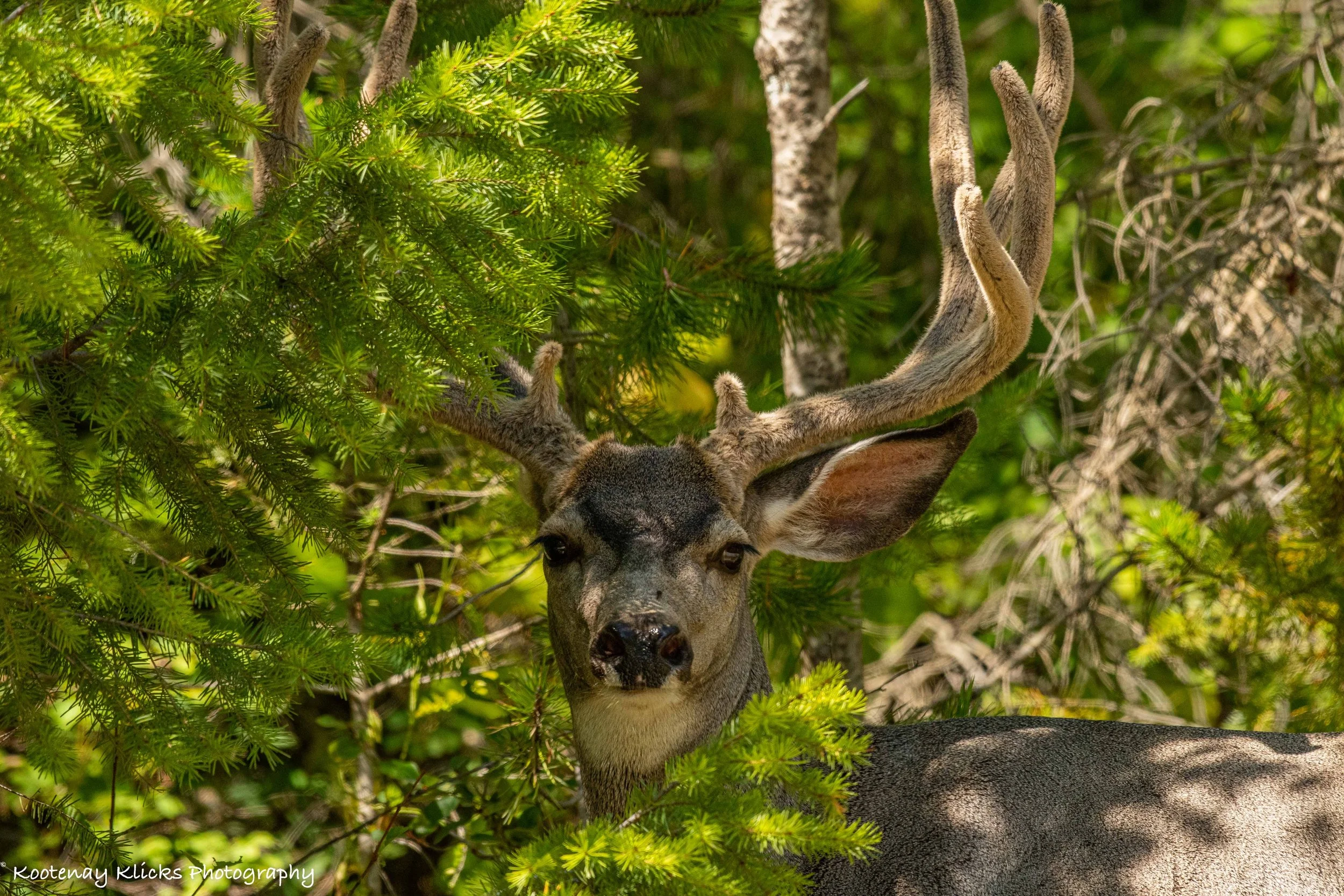
Mule deer buck in velvet blending in to its surroundings - East Kootenay region
Photograph © Jeremy Leete
So why the relentless and ongoing campaign by trophy hunting groups to sanitize their bloodlust and instead, portray themselves as philanthropic conservationists? They are determined to be seen as the good guys in the public sphere while demonizing those who oppose them. Regardless of the species, trophy hunters have found a way to justify killing them. In Africa and North America, the most common refrain is that trophy hunting raises money for conservation and feeds impoverished people. Close behind, is the argument for wildlife management which is a nicer way of describing population control. Trophy hunters have anointed themselves as the wildlife stewards most qualified to ‘manage’ wildlife and are all too eager to get out there and kill. In North America, wolves, cougars, bears (all species), coyotes, foxes, wolverines, beaver, deer, elk, caribou, and numerous other species all require managing according to the trophy hunting lobby. They have gamed the system that allows them to kill all matter of wildlife. If ungulate populations decline, they blame the predators, which provides justification to kill more predators. However, if the ungulates become over populated and see increases in diseases such as chronic wasting disease (CWD), they do not endorse increasing predator populations to help stem the spread of disease; rather, they campaign for increased hunting quotas of those ungulates. A study published in Conservation Letters - A journal for the society of conservation biology entitled, The elephant (head) in the room: A critical look at trophy hunting, Batavia et. al explains why trophy hunting should never be associated with conservation. “To transform them into trophies of human conquest is a violation of duty and common decency; and to accept, affirm, and even institutionalize trophy hunting, as the international conservation community seems to have done, is to aid and abet an immoral practice.”
So why the need for spin? Why is it so important to them to be seen as doing something positive rather than just owning that they take pleasure in trophy hunting? I asked this question on a number of the hunting social media pages I visited. Specifically, I asked, “Can any of you be honest and just admit that you enjoy killing animals?” While most did not answer and chose instead to hurl more insults at me, there were a couple who did admit that they enjoy killing wildlife. “I take pleasure in killing animals,” wrote Steven. “Do you feel better now?” Another commented, “I fucken love killing shit.” As disturbing as it was to hear, at least they were able to be honest about their intentions.
The narcissism component of the dark triad might well explain their need to be seen in a positive light, while portraying their detractors as weak, uneducated, and ignorant. A May 15, 2023 article written by Professor Geoffrey Beattie FBPsS, FRSM, FRSA and published in AWSELFA entitled, The Psychology of Trophy Hunters, explains why trophy hunters feel the need to be seen in a favourable light:
The psychological process of how we are able to construct others (or indeed ourselves) using language such as caring about animals and yet, and at the same time, capable of killing them for sport (and indeed proud of it) is also a core consideration for any attempt at a psychological explanation. For example, in their accounts of their own actions, terrorists will often construct themselves as kind-hearted and caring individuals whilst at the same time describing those callous barbaric acts that they have been engaged in (Beattie 2004). Their own self-construction of their positive qualities is often paramount when they talk about what they did in pursuit of this or that political or ideological goal, as is their (explicit or implicit) blaming of the victims (Beattie 1992; 2004). We often find exactly the same thing with trophy hunters.
Conservation or Self-Interest?
And blaming their victims is one way trophy hunters justify killing their quarry. As mentioned earlier, one rationale is wildlife ‘management,’ a term that can serve to sanitize the killing of wild animals. At times, it seems as though they are trying to convince themselves as much as their audience that they are acting in the name of conservation. Professor Beattie raises an interesting question about whether displaying dead animals can serve as a narcissistic strategy to elevate social status and reinforce an inflated sense of self-esteem. I suspect that, for some trophy hunters, the answer is a resounding yes.
Closer to home, I viewed numerous photographs of hunters proudly posing with dead wolves, cougars, bears, coyotes, elk, sheep, moose, and deer. More often than not, the animals were displayed in ways that appeared intended to emphasize the hunter's superiority over their prey. It was as though demonstrating dominance over another creature somehow affirmed their masculinity. In one photograph posted by Yukon Big Game Outfitters Ltd., a trophy hunter held up a large wolf he had just shot. The accompanying caption read, “They don’t get this big eating rabbits? Wonder what chance a caribou has when a pack of these lock in.” The implication was clear: killing the wolf was being presented as a means of protecting caribou. Yet the accompanying photograph, showing the hunter smiling broadly while embracing the dead animal from behind, suggested something considerably more celebratory than a solemn act of wildlife conservation.Another man commented, “Wolves kill for sport, kill everything including human beings. They also eat prey alive.” Beyond the sweeping inaccuracies in his statement, the irony of accusing wolves of killing for sport while defending trophy hunting appeared entirely lost on him. Still another, in a rare moment of candour, wrote, “Absolutely outstanding hunt, what a mount.”
In a similar post where the hunter is posing in much the same way, only this time with a cougar he had just killed, one supporter replied:
You do realize people eat mountain lion right? It's actually very, very good. It’s not just about going out and killing something for the hell of it, WE EAT what we harvest. And remember this, if it weren't for HUNTERS and ANGLERS, there really wouldn't be hardly any animals left. It was the hunters that saw the declining populations and worked to get seasons and quotas set. Every gun, all ammo, archery gear, fishing gear, a certain % goes DIRECTLY to conservation. How much do you give to conservation efforts?
What he conveniently overlooks is that overhunting, commercial hunting and trapping were among the very activities responsible for devastating wildlife populations in the first place. While hunters and anglers have undoubtedly contributed to conservation efforts, those contributions do not grant them exclusive ownership of conservation or place their activities beyond ethical scrutiny. The endless rationalizations are truly remarkable. And as for his question about who contributes the most to conservation, I would suggest that it is the animals themselves, who pay with their lives to satisfy the trophy hunter's perverted idea of conservation.
Power, Influence and Wildlife Management
So then, how does the Machiavellian component fit the trophy hunter’s psyche? To recap, Machiavellianism is a character trait where one is so focused on their own interests they will manipulate, deceive, and exploit others to further their own goals and pursuits. According to Aimee Daramus, a Chicago based clinical psychologist who was quoted in an October 7, 2021 article in Psych Central, “In nature, you see a lot of kindness, nurturing, and family among animals, but if they want to survive, they still have to eat other animals unless they’re herbivores.” Daramus goes on to explain (paraphrased by the article’s author, Simone Marie), that “Someone with a Machiavellian personality will ascribe to this way of life — even when it’s not a life or death situation, but merely to their advantage.”
Not surprisingly, those with a high MACH-IV score (a psychological index used to measure the degree to which a person displays Machiavellian traits) are often in leadership and political positions. It would not be a stretch to assume that many of the current political leaders in the US, and some in Canada, would score very high on the MACH-IV index.
Psychology Today, a renowned online magazine, reports that there is evidence suggesting “that people high in Machiavellianism are more likely to pursue high-power careers such as politics or law.” In Alberta, Canada, there is an outfitter/trophy hunter turned politician, who became an elected Member of the Legislative Assembly (MLA). He was able to secure a portfolio that put him in charge of wildlife management among other things. Besides the obvious conflict of interest, why would he even want to be in charge of wildlife stewardship when he, before turning to politics, made his living by killing, or facilitating others to kill, wildlife? If one looks at it from the Machiavellian perspective, it makes perfect sense.
Research into Machiavellianism has also explored its relationship with the pursuit of power and influence. That raises an interesting question: what happens when someone with a professional background in exploiting wildlife for commercial gain becomes responsible for managing and protecting that same wildlife?
Consider Alberta's Minister of Forestry and Parks, Todd Loewen.
Before entering provincial politics, Loewen owned an outfitting business, Red Willow Outfitters. Although the business subsequently came under family ownership, its continuing connections to the minister have raised questions about competing interests between the outfitting industry and his responsibilities as a public official. Those questions become particularly relevant when examining Alberta's wildlife management decisions. Under Loewen's tenure, the province expanded cougar hunting opportunities, removed trapping limits for several furbearing species, including wolverines, and authorized a limited hunt involving designated problem grizzly bears. These decisions have garnered criticism from conservation organizations concerned about their scientific justification and ecological consequences.
Loewen has defended predator management as an integral component of protecting ungulate species. “Managing predator populations is also an important part of protecting threatened species like caribou, and big game animals like bighorn sheep, moose, and elk.” , including caribou, bighorn sheep, moose and elk.” He has also emphasized the role of hunting in managing cougar populations.But that raises another question: whose interests are being served? Reducing predator populations can also benefit hunters seeking the ungulates those predators naturally prey upon. In other words, policies presented as wildlife management may simultaneously create opportunities for an industry whose commercial interests depend on the continued availability of huntable animals.
From my perspective, this is exactly why the relationship between wildlife management authorities and the industries that profit from killing wildlife deserves much closer scrutiny. It does not require a psychological assessment of Minister Loewen to question whether these policies adequately serve the broader public interest, or whether the interests of hunters and outfitters have been given disproportionate influence over wildlife stewardship.
Ecologist Craig Packer, who has spent decades studying lions in Tanzania, has also drawn attention to the influence of political and cultural identity on attitudes toward wildlife conservation. In an interview with The Guardian, he described how political affiliation, religious beliefs and rural identity can shape some hunters' responses to evidence that wildlife populations are threatened.
I've encountered similar political defensiveness in my own exchanges with hunters. In one particularly revealing response to my criticism of trophy hunting, a hunter replied, “You probably voted for Trudeau.” Apparently, questioning the recreational killing of wildlife was enough to establish my political allegiance. Who knew?
“Are we protecting wildlife for its own sake, or protecting it so that people can continue paying for the privilege of killing it?”
As for the psychopathy component of the Dark Triad, that is considerably more difficult to assess. Some hunters openly acknowledge taking pleasure in killing animals, and I find that admission deeply troubling. But enjoying an activity that involves killing does not, in itself, establish psychopathy or sociopathy. Psychopathy encompasses a broader pattern of personality characteristics, including callousness, diminished empathy and lack of remorse. These traits cannot be reliably established from social media comments or hunting photographs alone. Nevertheless, I believe there is a legitimate ethical question here. When someone derives pleasure from deliberately ending the life of a wild animal, particularly when the killing is undertaken primarily for recreation or a trophy, what does that reveal about their capacity for empathy toward other living creatures? And when the killing is subsequently justified through appeals to conservation, are those arguments always expressions of genuine concern for wildlife, or can they sometimes serve to rationalize an activity whose principal reward is personal gratification?
The fact that trophy hunting lobby groups so frequently resort to the familiar argument that they are conservationists or humanitarians suggests they are missing the fundamental point. Whatever conservation benefits they claim, those arguments do not erase the pain and suffering inflicted on sentient beings for the sake of recreation and personal gratification. What I find particularly disturbing is how readily that suffering can be dismissed or rationalized, often with little apparent consideration for the animal itself. “You can see that there is likely to be a close link between these personality dimensions and trophy hunting, given that trophy hunting necessarily involves animal suffering and therefore animal cruelty,” explained Beattie referring to the dark triad. “A lack of empathy and a degree of callousness may well facilitate trophy hunting (and may even be necessary conditions for trophy hunting), and trophy hunting and its depiction in images and films may well facilitate the maintenance of narcissistic flow (another necessary condition).”
Toxic Masculinity and the Need for Dominance
I would also argue that toxic masculinity plays a role in some of the attitudes surrounding trophy hunting, judging by the hundreds of disparaging comments I received in response to my opposition to the practice.
But how does toxic masculinity relate to the Dark Triad? Is it an additional psychological dimension, or do certain characteristics associated with narcissism, Machiavellianism and psychopathy overlap with harmful expectations of masculinity? I suspect there is considerable overlap, particularly when it comes to dominance, entitlement, grandiosity and the need to project superiority.
Consider Jonathon's response to my criticism: “You pee sitting down and hold your pinky out while drinking out of a straw is what I get out of that.” Apparently, questioning the killing of wildlife was enough to call my masculinity into question. Todd offered another example of the contempt directed at those who challenge hunting: “There's a dumbass that's never hunted and has no idea about the damage wolves or even coyotes do.” And then there was Dale, who took the hostility a step further: “I enjoy killing wildlife. I also enjoy playing hockey, playing baseball, bitchslapping mouthy dweebs, woodworking, and more. So what?” What I find particularly revealing about these responses is how quickly a discussion about the ethics of killing wildlife becomes an attack on the person raising the question. Rather than engaging with the suffering of the animal, the conversation shifts to masculinity, personal superiority and, in Dale's case, the suggestion of physical intimidation. Whether these responses reflect underlying personality traits, culturally reinforced attitudes about masculinity, or some combination of the two, they raise questions about the hostility directed at those who challenge trophy hunting.

Large bull elk grazing by a lake near Jasper, Alberta
Photograph © Jeremy Leete
What became very clear to me over the course of doing research for this article was that many trophy hunters have an intense need to feel superior, not just to the animals they kill, but to those who choose not to kill wildlife for sport. They purposefully diminish and demean those who oppose them by portraying them as weak and ignorant, often describing them with feminine traits, which really just speaks to their misogyny, toxic masculinity and fragile male egos. They are also resolute in defending what they do by framing it as necessary for conservation as well as humanitarianism purposes, but rarely admit to taking pleasure in the act of killing. They often demonize predators to sway public opinion in their favour. They seem to lack empathy for the animals they hunt, and take enormous pleasure in ending their lives, despite what they may tell you. And lastly, most appear to equate trophy hunting with strength and masculinity, ignoring the obvious fact that overcoming the primitive urge to hunt and kill, requires much more strength of character than to give in to it.
Whether or not trophy hunters possess varying degrees of the personality traits associated with the Dark Triad will undoubtedly remain a subject of debate. But regardless of their psychological makeup, I believe there must be a darkness in their souls to deliberately stalk and kill wildlife for the sheer pleasure of it.
Imagine, for a moment, being a trophy hunter who releases a pack of hounds in pursuit of a cougar. The animal flees, eventually seeking refuge high in a tree, with the dogs barking relentlessly below. The hunter arrives, raises a rifle, takes aim at an animal that has nowhere left to escape, and pulls the trigger.For what? The satisfaction of having killed a wild creature? The admiration of fellow hunters? Another trophy to hang on the wall? Whatever the motivation, the animal pays the ultimate price for an experience that could have been replaced by any number of nonlethal pursuits offering excitement, challenge and a connection with nature.
When you seriously consider what trophy hunting involves, it seems extraordinary that killing wild animals primarily for recreation remains a socially accepted and legally sanctioned pastime in many places. Hunting has been part of the human experience for thousands of years and, for much of that history, was essential to survival. Today, however, hunting encompasses everything from subsistence and food procurement to recreation and trophy collecting. I have no objection to those who genuinely depend on hunting to feed themselves and their families. My objection is to killing wild animals primarily for personal gratification, particularly when the animal's death becomes a source of pride or prestige.
Yet hunting continues to be celebrated as a noble pursuit in many circles. During the 2024 American presidential campaign, Minnesota Governor Tim Walz publicly embraced his identity as a hunter while running for vice president. His example illustrates how closely hunting can remain intertwined with cultural identity and political image, even as public attitudes toward our relationship with wildlife continue to evolve.
The Moral Cost of Trophy Hunting
For trophy hunting to be seen for what it is, I believe there needs to be a fundamental shift in how we view the animal kingdom and what constitutes acceptable treatment of nonhuman sentient beings.When children or teenagers deliberately abuse animals, such behaviour is rightly regarded as a serious warning sign. Research has established associations between repeated childhood animal cruelty and other forms of aggression and antisocial behaviour. Yet when adults deliberately pursue and kill wild animals primarily for the purpose of displaying their remains as trophies, the activity is celebrated by some as sport. The distinction may be legally and socially accepted, but from an ethical standpoint, I find it deeply troubling.
I remain convinced that certain characteristics associated with the Dark Triad may help explain the motivations of at least some individuals who derive pleasure and prestige from killing wildlife. But whatever the psychological explanation, the extent to which trophy hunting has become intertwined with wildlife conservation is of profound concern to me.
When conservation organizations become financially dependent on revenue generated through trophy hunting, an uncomfortable ethical dilemma arises: are we protecting wildlife for its own sake, or protecting it so that people can continue paying for the privilege of killing it?
I think of it as kidnapping in reverse. Wildlife is effectively held hostage, but the ransom is paid for the right to kill the captives rather than to secure their freedom. This concern is shared by conservation ethicists Chelsea Batavia and her colleagues, who argue that conservation cannot be judged solely by population numbers or financial returns. The dignity and welfare of individual animals must also matter. Their research challenges the conservation community to consider whether accepting trophy hunting as a necessary means of protecting wildlife risks compromising the very ethical principles conservation ought to uphold.
And perhaps that is the question we should have been asking all along: What does it say about our relationship with wildlife when we believe we must kill animals in order to save them?
- No lives were taken in the making of this article -
Originally published March 22, 2025, on Wild & Woke.