
What the commercial fur trapping industry does not want you to know
“CAUTION REG. TRAPLINE” are the words I read on the red sign posted on the tree. “ACTIVE SNARING & TRAPPING.” My heart sinks knowing the indescribable suffering that has taken place, and will continue to happen just beyond this sign. I imagine the animals struggling to free themselves. The panic, the fear, the pain as the neck snare tightens with every attempt to escape the metal noose. I am overcome by an unyielding need to venture in and disable every trap I find, but I stop myself. It is a bitter irony knowing that doing so, and sparing numerous animals from a prolonged and painful death, would put me at odds with the law while the perpetrator of this intentional torture is doing so legally.
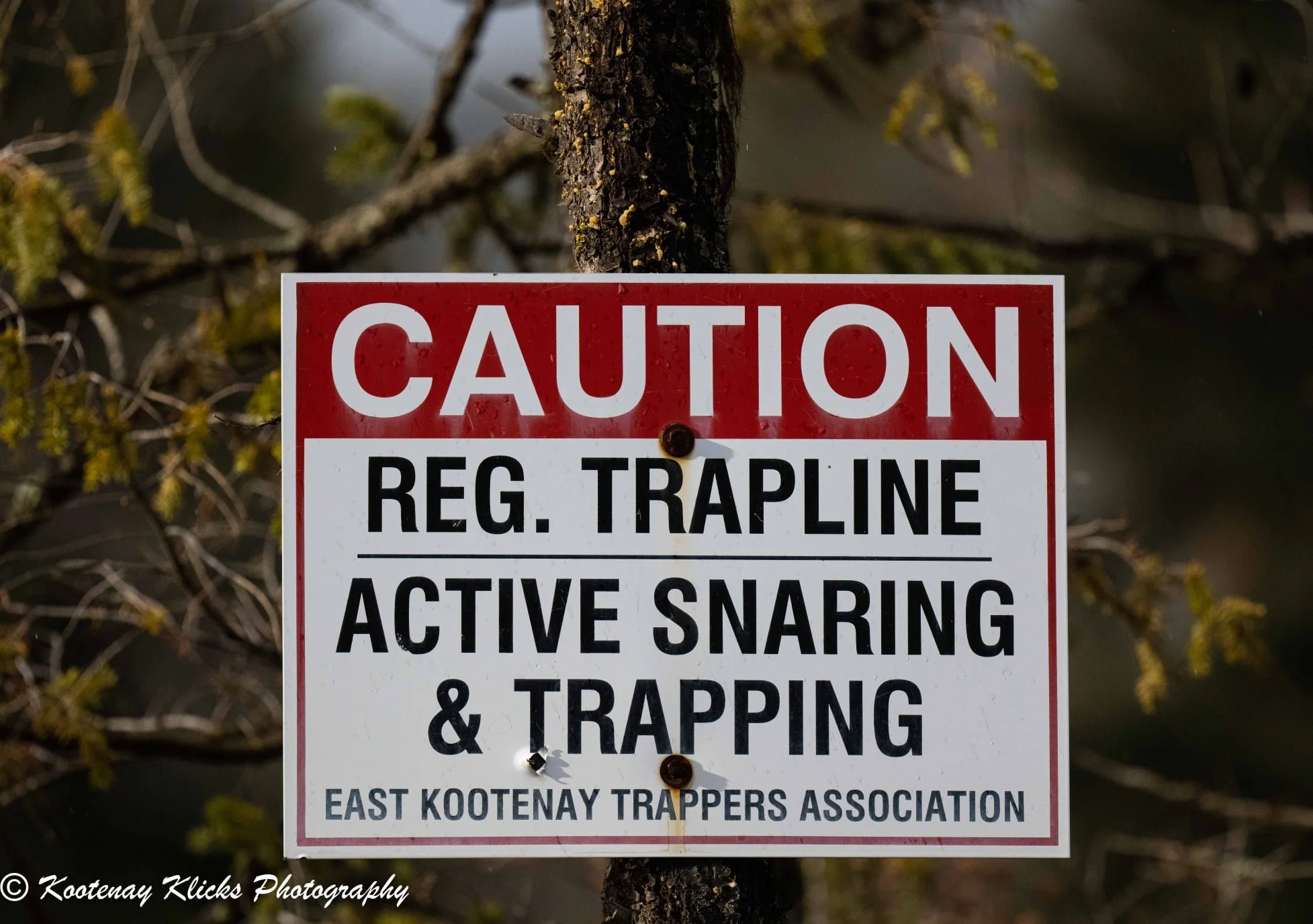
Active trapping and snaring warning sign in the East Kootenay region of British Columbia. Photograph © Jeremy Leete.
This entire area now seems like a contradiction. I have come here to decompress and listen to the rushing water of the nearby stream while waiting to photograph wildlife. This is my self-care ritual - immersing myself in nature and taking in all the life that surrounds me. But rather than feeling relaxed and content, I am filled with a toxic mixture of anger and contempt knowing that in this moment, I am powerless to help the ill-fated animals that are drawn into this area by the bait the trapper has left. To me, it is incomprehensible that someone could intentionally inflict such suffering on other sentient beings as a way to earn money.
This is certainly not the image the commercial fur trapping industry wants you to envision. In a world that is increasingly rejecting the fur trade, commercial fur trappers are scrambling to stay relevant. If you have ever been inclined to check out the various trapping associations’ websites, you will see that they are filled with stories and pictures about the bygone days of an era that was wholesome, family oriented and steeped in tradition. Take, for instance, The BC Trapper’s Association’s ‘Welcome’ page that claims they are, “A dedicated, compassionate community of trappers,” and that, “as stewards in British Columbia, we manage furbearers responsibly and sustainably through respect of our natural resources.” How about the Alberta Trapper’s Association’s ‘About’ page which similarly states, “We see an Alberta where the sustainable harvest and management of wild furbearers is an established and recognized conservation activity that is integral to our heritage, culture and identity.” It’s worth noting that when people opposed to these practices use terms such as compassionate, respect, responsible, stewardship, etc., they often get labelled as radical by these very associations.
But do these feel-good and benevolent claims to be nature’s guardians play out in reality? This article will challenge those notions arguing that the commercial fur trapping industry causes immense suffering to the animals targeted and that the traps they list as humane, are anything but. To intentionally inflict pain, to deliberately asphyxiate, to knowingly cause fear, anxiety, stress, are all considered forms of torture when perpetrated on humans. With animals caught in killing traps, however, it is considered humane if the above methods lead to irreversible unconsciousness within a certain time frame. Similarly, restraining traps are considered humane based on their ability to prevent serious injury. Neither considerations take into account the psychological trauma of stress, anxiety and fear that traps inflict on wildlife. As a species capable of compassion and empathy, does the inhumane practice of commercial fur trapping fit within the framework of what we claim to be as human beings? We have rules, laws, and norms to govern our behaviour towards one another, but none apply to how we treat wildlife. And until they do, can we really claim to be a humane species?
CLANDESTINE TRAPPING
For the most part, the trapping industry has continued to operate in relative secrecy with the general public remaining largely oblivious to the staggering number of animals they kill as well as the ongoing suffering they cause with their trapping methods. In an 2019 article in the Earth Island Journal entitled Hanging on, Camilla Fox, founder and director of Project Coyote, stated, “I think most people are generally unaware that commercial trapping is still happening around the United States.” The article also details how there are no federal reporting requirements for trappers as it is left up to individual states to monitor. “The most recent nationwide data, from two decades ago, estimates that some 4.6 million animals — including raccoon, fox, bobcat, opossum, nutria, muskrat, coyote, wolves, and more — were trapped during the 1998-99 season.” Because of this haphazard method of reporting, the actual numbers are likely higher. The article goes on to say that a lack of regulations also increases animal suffering. “And today we know through scientific research that the standard body-gripping traps used in commercial trapping and animal control trapping, are inherently non-selective, and that they can cause tremendous pain and suffering to individual animals, even leading to animals gnawing off their paws. It’s not unusual for people to report seeing a three-legged coyote, for example.”
It is no different in Canada, as commercial fur trapping is happening all over the country, with a majority of Canadians remaining oblivious to the staggering number of wild animals being trapped and killed annually. “38 per cent of Canadians don't realize that industrial trapping is legal,” according to Exposed Wildlife & Nature Conservancy, “while even more don't know that thousands of wild animals are trapped each year for their pelts.” The Conservancy lists the top ten species in Canada trapped during the 2020-21 season in descending order from highest to lowest number trapped, which include: coyote, muskrat, beaver, marten, fox (red, cross, silver), weasel, raccoon, red squirrel, fisher, and mink. In total, the number trapped and killed for their pelts amounts to 375,409 animals (stats from The Fur Bearers Association).
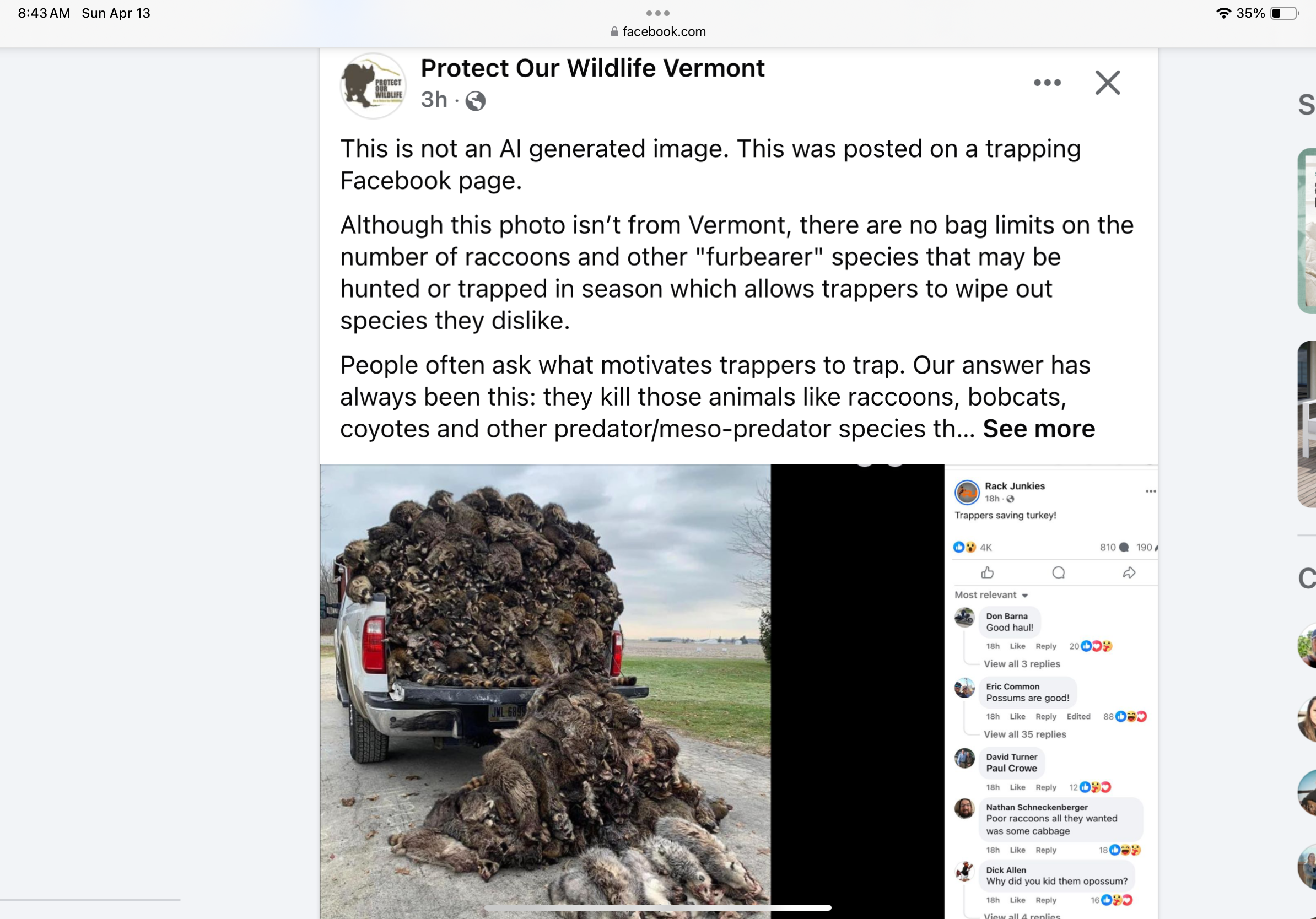
Screenshot of a Facebook post shared by Protect Our Wildlife Vermont, featuring a photograph reportedly originating from a trapping-related Facebook page.
Much like trophy hunters, commercial fur trappers have inserted themselves into the conservation arena claiming they are an integral and necessary part of wildlife management and conservation. As the above photo illustrates, this is an inherently flawed and biased strategy when it comes to wildlife stewardship as it turns it into a system of conservation for profit. The trapping lobby has been quite effective in their messaging, gaslighting the public into believing that trapping is a humane, ethical, compassionate and effective way to help manage wildlife populations. I can say with 100 per cent certainty that it is not. After having watched numerous videos of wolves, coyotes, foxes and other predators, struggling for hours trying desperately to free themselves from neck snares, there is nothing humane about it. Writhing in agony with each tug, spin, and roll, the snare cinches ever tighter. The more the animal struggles, the tighter it gets. Eyes wide with fear, the animal pants, growls, and yelps in this drawn out struggle which it cannot win. It is unbearable to watch, but I make myself do so knowing it will spur me on to expose this cruel and antiquated practice.
TYPES OF TRAPS
Understanding how traps work is essential in order to recognize how they cause prolonged animal suffering. There are four main types of government approved traps predominantly used by commercial trappers in Canada - the leg-hold trap, cuff-style trap, snare trap and Conibear trap. The latter two are supposedly killing traps while the former are restraining types. All four are considered humane according to the trapping industry, but are they? Only three meet the Agreement on International Humane Trapping Standards (AIHTS), with the snare trap being the exception. The AIHTS set the standards for which the various types of traps must meet in order to be considered humane. It’s interesting to note that the Government of Canada’s website states that it, “provides funding to the Fur Institute of Canada for trap research and testing to ensure traps used in Canada can be certified in compliance with the AIHTS.” Yet, the snare trap, one of the most commonly used traps by commercial trappers in Canada, does not come close to meeting this standard. More on this later in the article.
Leg-hold traps, according to The Fur Bearers Association, a Canadian charity that advocates for the protection of fur-bearing animals, “. . . are designed to hold a wild animal who does not want to be caught. In their distress and panic, some animals become so desperate to escape that they resort to chewing or wringing off their trapped limbs, breaking their teeth and bones in the process.” To claim that animals suffering through this process are being treated humanely, seems ludicrous. The Association further explains that, “Animals endure a painful and panic-filled period until they either die from exhaustion, blood loss, predation, dehydration, hypothermia, or are clubbed, choked, or stomped to death by the trapper (so as not to damage the pelt).”
The cuff-style trap was apparently designed as a solution to prevent dogs from becoming trapped. They are primarily used to trap smaller animals like raccoons, where the bait is located at the end of a cylinder and the raccoon must reach in to get it, becoming trapped in the process. The result, of course, is total panic and in many instances, the raccoon will chew off its own limb trying to escape, even though this type of trap is meant to prevent that. Again, it’s difficult to reconcile how this could ever be considered humane.
The Conibear trap is a type of killing trap that is supposed to be instantly lethal. In reality, that is often not the case. There are inherent flaws in its design that fail to take into account variation in animal sizes and the position of the animal when the trap is activated. Because of this, as the The Fur Bearers Association explains, “when the trap gets triggered, it can clamp down on the animal without killing them, resulting in agonizing pain and a prolonged death.” Perhaps even more concerning is that in some provinces in Canada, trappers can go as long as fourteen days without checking the trap. Yet somehow, this type of trap still meets the standard for AIHTS approval.
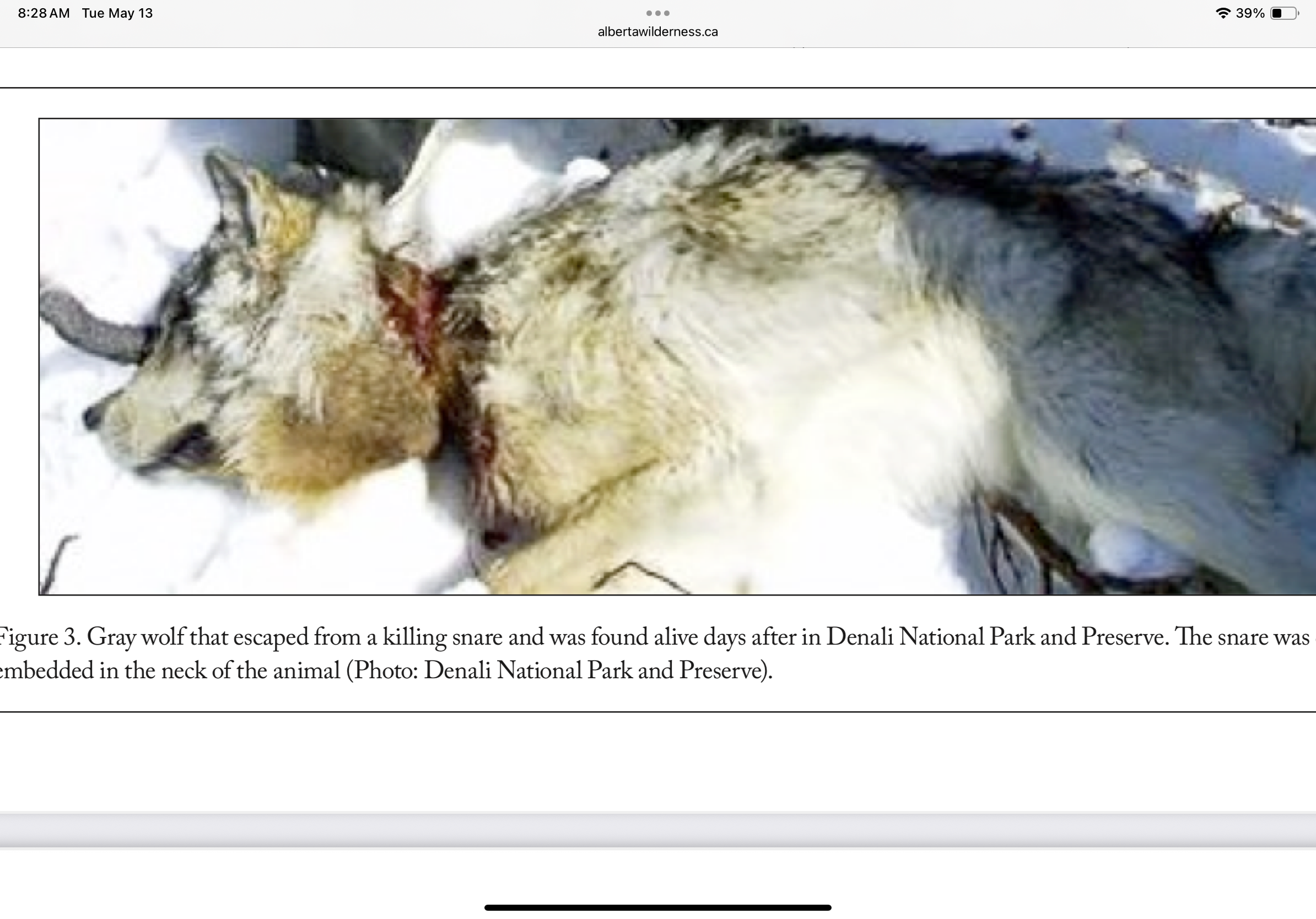
Last, and definitely worst, are the notorious snare traps. Out of all the traps used in Canada, not only does this one cause immeasurable suffering, it is almost as if it was designed to do so intentionally. This is the go-to trap to ensnare wolves, coyotes, foxes and other medium to large predators. The snare is set at the approximate head height so the unsuspecting animal walks right into it. When the animal first feels the snare pressure, it immediately darts, which causes the snare to tighten around the animal’s neck, or other parts of the body. This provokes a panic response as it desperately tries to free itself. The more it struggles, the tighter the snare becomes. And despite the trapping industry’s claims to the contrary, more often than not, the snare does not cinch up tight enough to cut off blood flow and oxygen to the brain, making for a very prolonged and torturous experience for the animal, which ultimately does end in death.
GOVERNMENT COMPLICITY
Although used extensively by commercial trappers, the neck snare is not considered to be a commercial device, which has created a giant loophole for trappers - no pun intended. In a 2015 Canadian Wildlife Biology & Management study entitled, Humaneness and Selectivity of Killing Neck Snares Used to Capture Canids in Canada: A Review, the authors found that, “Although killing neck snares are commonly manufactured and sold on the open market, they are deemed by all relevant Canadian competent agencies to be non-commercial devices and therefore not subject to the AIHTS.” In order to be compliant with the AIHTS, neck snares would have to cause the death of the trapped animal in under three minutes. The fact that neck snares have been proven to cause prolonged suffering that can last for hours and even days, makes one wonder if exempting them from commercial status in Canada was intentional to placate the commercial trapping industry by the Canadian agencies responsible for overseeing them. The allowance of this trap completely contradicts the Government of Canada’s claims of ensuring that all trapping methods are AIHTS compliant. It begs the question that if these are considered non-commercial devices, then why are trappers allowed to use them for commercial purposes? It also raises a subsequent question that if these traps are considered inhumane for commercial use, then why are they not for non-commercial purposes? Inhumane is inhumane no matter the intention, is it not?
In a three-part video series produced by Exposed Wildlife Conservancy entitled, The Truth About Snares, John E. Marriott, a conservationist and renowned wildlife photographer, reveals how widespread and inhumane this method of trapping is. Much of the content is difficult to watch, but essential in understanding how cruel trapping can be. “Killing neck snares have never been proven in killing animals humanely and efficiently,” explains Marriott. “They do not kill in under three minutes which is what the AIHTS agreement states. Canada signed on specifically excluding neck snares knowing that they’re not humane, they’re not efficient.” He goes on to explain that commercial trappers are using these snares all across Canada and in a number of US states because they are simple to use, very cheap to purchase, and very effective at trapping animals, despite being completely ineffective at reducing lengthy suffering times.
It’s worth noting that the bar is already set quite low by the AIHTS to meet their standards for what is considered humane trapping because, after all, it is an agreement among various governments and the fur industry itself. It deliberately ignores new scientific recommendations that would improve trapping methods and reduce animal suffering. In a book entitled, Mammal Trapping - Wildlife Management, Animal Welfare and International Standards, Gilbert Proulx, Director of Science at the Alpha Wildlife Research & Management Ltd. as well as the Editor-in-Chief of Canadian Wildlife Biology & Management, discusses this in-depth stating, “Such standards were vehemently criticized by many wildlife professionals over the years, and in 2020, a few colleagues and I pointed out that the AIHTS did not represent state-of-the-art trapping technology when it was signed in 1997, and it definitely failed to properly address animal welfare in trapping.” Proulx went on to explain how members of trapping industry did not take these recommendations seriously. “Individuals involved in pest control and fur trapping dismissed or downplayed the concerns raised by professionals, naturalists and conservation organizations about mammal trapping, and claimed that all these people were unrealistic and unpractical.”
How is it then that the Government of Canada will not ban the use of snare traps knowing that they are cruel, inhumane and fail to meet the most minimal standards set forth by the AIHTS? Their own words stand in stark contrast to their policy as it states, “This agreement (AIHTS) is important to Canada because trappers and communities rely on the exporting of fur to the European market as a means of income and because the application of the standards assures acceptable animal welfare is achieved in the trapping of wild species for any reason in Canada.” This is a flat-out lie as they are well aware that neck snare traps do the exact opposite of assuring animal welfare.
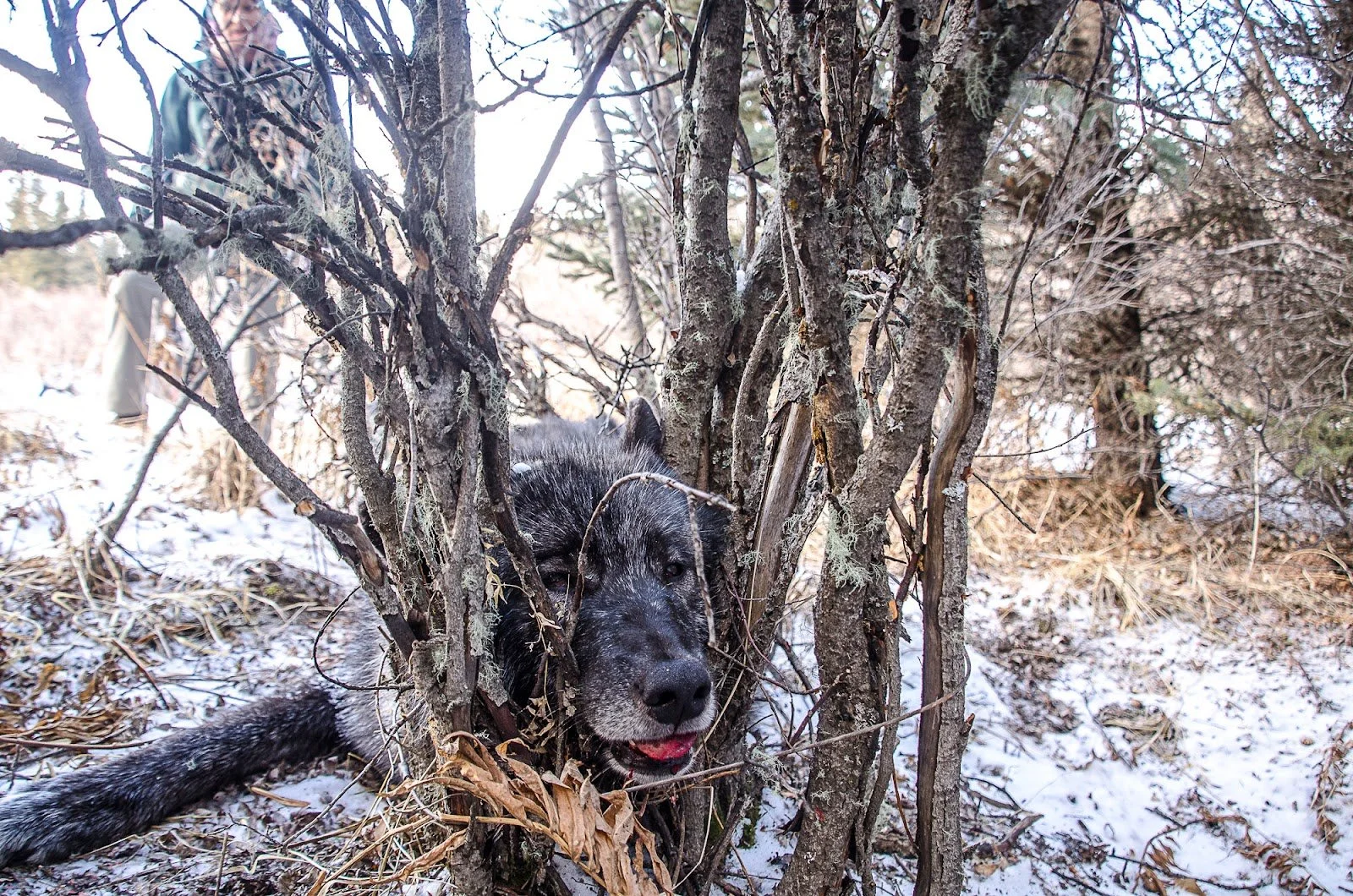
Asphyxiated wolf after being lured into a snare trap.
The Criminal Code of Canada prohibits anyone from willfully causing animals to suffer from neglect, pain or injury. Completing this cruel trifecta, the commercial fur trapping industry operates with impunity because wild animals are excluded from this legislation. The BC Prevention of Cruelty to Animals Act in the section entitled, Harm to animals by persons, specifically states, “A person must not cause an animal to be in distress; a person who kills an animal; must comply with prescribed requirements; and must not, in killing the animal, cause the animal to be in distress or do anything that is prohibited by the regulations.” Causing animals to be in distress, no matter the trap type, is inevitable with commercial fur trapping, but again, wild animals are not deemed worthy of protection under this act.
TRAPPING ASSOCIATIONS & NECK SNARES
I reached out to both the BC and Alberta Trappers Associations as well as the Canadian Fur Institute asking why they continue to use neck snares knowing that they are not AIHTS compliant and cause prolonged suffering to the animals they ensnare. I received a reply from Bill Abercrombie of The Alberta Trapper’s Association, and rather than answer my question, he instead, chose to lash out verbally as he wrote, “Trying to explain anything to you and your ilk (Marriott) is a waste of time. You have no interest in facts or truth. Do some fact checking on your own and demonstrate some sort of rational thought process by writing something truthful for once. Until then bugger off and don’t contact us again please.”
In a subsequent email reply, he continued his tirade:
“We have been down this road before with your buddy Marriott, and our side never saw the light of day. We tell our side of the story to responsible journalists who print what we actually say. We present factual data to stakeholders, researchers and society in general on a daily basis. Why you would think we would waste our time explaining anything to the animal rights lobby who are only interested in promoting their own narrative and nobody else’s is beyond me? There is a lot of factual data out there if one bothers to look. Print something true…show me you did, and then we’ll talk. Until then I’m busy.”
I sent a reply stating that my goal is to always get at the truth and if he can provide me with factual information to refute what I asked in the original email, I would quote him verbatim. I have yet to hear back, nor have I received a reply from anyone representing the BC Trappers Association or the Canadian Fur Institute.
THE FALLACY OF WILDLIFE MANAGEMENT
There is a continuum of what defines humane trapping depending on various points of view and stakeholder interests. With commercial trapping, the end goal is always the death of the animal so the definition of humane treatment centres more around how much suffering is acceptable prior to the death of the trapped animal. I would argue that, because there is no need for a commercial fur trapping industry, no amount of animal suffering is acceptable for the purpose of selling fur for profit. Of course, commercial fur trappers would disagree with me as they vehemently argue that their trapping activities are more than just about selling furs; rather, they are an essential component of wildlife management and population control. Proulx disputes these claims made by commercial fur trappers as he wrote in a 2022 paper entitled, The 5 W’s of Mammal Trapping:
“. . . Contrary to the claims made by some people and organizations, trappers are not wildlife managers. . . Generally trappers do not monitor the status of populations, natality, and mortality rates, age and sex ratios, and home ranges (which may encompass many trap lines) vs habitat changes. Trappers do not address management intricacies associated with species reintroduction programs, species at risk, and new taxonomic classifications.”
Having over four decades of experience as a wildlife biologist as well as being a trapper himself, Proulx is uniquely qualified to provide insight into the trapping industry as a whole and the commercial fur trapping industry in particular. Despite the obvious conflict of interest with commercial fur trappers managing wildlife, Proulx believes fur trappers are completely unqualified to be managing wildlife in the first place. “While wildlife managers take into account human activities, they must protect native biodiversity (individuals, species, populations, ecosystems) and the ecological functions and processes that maintain biodiversity. These are hardly the activities of fur trappers.”
Proulx also points to evidence that indicates fur trappers’ eagerness to participate in any type of management is closely tied to the value of pelts. In other words, if there is little profit, there is little incentive to participate. “Effective wildlife management is not a part-time activity,” Proulx insists. “It requires consistent, reliable, and factual information about populations and habitats. Wildlife population analyses and wildlife management programs should be re-assessed on a yearly basis independent of fluctuations in pelt value or other economic factors associated with fur harvests.”
So, are commercial trappers’ claims of being integral to wildlife management and stewardship legitimate or is it more likely a propaganda campaign designed to sway public opinion in their favour? It would seem the latter is more likely. One of the more hypocritical claims made by The Alberta Trapper’s Association is that they actually prevent animal suffering with their trapping practices as their website states, “Without trappers, nature controls furbearer populations through habitat or climatic change, predation, competition, starvation, stress and disease. This leads to prolonged suffering and the inevitable large scale swings in the population of different species from one year to the next.”
For this association to claim that they are preventing prolonged suffering when they employ traps, such as neck snares, that do the very thing they are claiming to prevent, reveals that they are not acting in the best interests of wildlife and are intentionally misleading the public. Of equal concern is their claim to be ‘fully utilizing’ the animals they harvest. Consider the following statement by the Alberta Trapper’s Association:
“Responsible and humane management by trappers maintains furbearer populations at healthy sustainable levels. All animals harvested by trappers are as fully utilized as possible with unused portions being returned to the ecosystem for the benefit of all wildlife. All lands and wildlife will be treated with compassion, dignity and respect.”
Those unused portions they refer to are often the skinned carcasses of the trapped animals left to decompose that attract more animals into the trapping area. Is discarding the entire body of a skinned animal treating that animal with compassion, dignity and respect?
While exploring a local trapper’s trap line in the video series mentioned earlier, Marriott sought the location of a wolf that had been reported struggling to free its leg from a snare. He found only blood spatter presumably as a result of the trapper returning and shooting the wolf. However, that was only one of several disturbing discoveries. “I did find three dead wolves, nine coyote carcasses, and four red foxes all skinned and left behind to rot,” explains Marriott. “Perhaps surprisingly, what this trapper is doing on his trap line, is totally legal. It happens all across Canada, much more than you might think.” But of equal concern, continues Marriott, is that in Alberta, for only 40 dollars, trappers can purchase a license that allows them to snare an unlimited number of wolves, coyotes and foxes from October through March. How can this be considered a sound conservation strategy when there are no limits placed on the numbers of animals being harvested as well as few limits on the length of time and severity of the suffering they will have to endure?
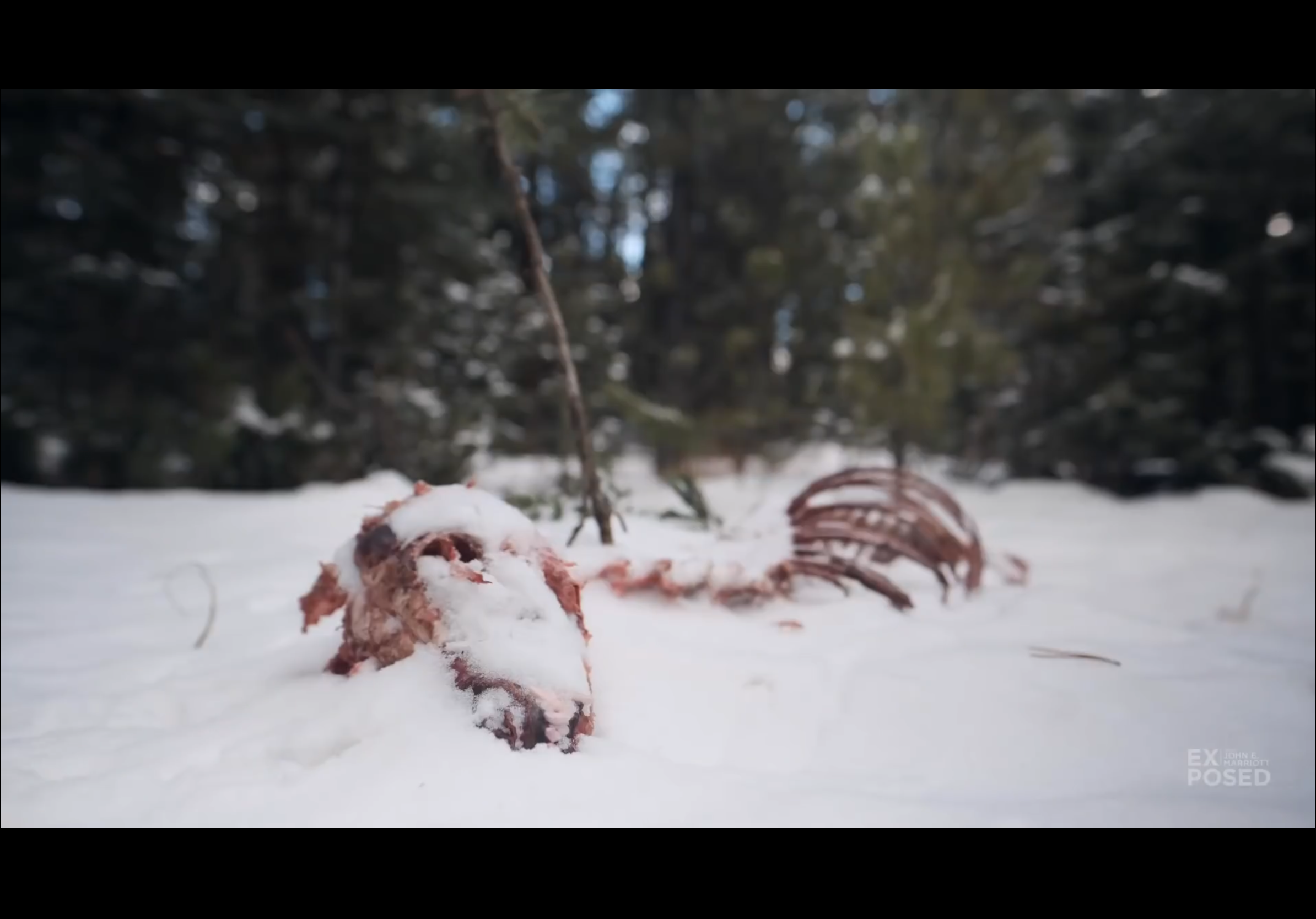
Wolf carcass discarded by the trapper after skinning it. Photograph © John E. Marriott / Exposed Wildlife Conservancy.
THE MESSAGING DISCONNECT
How do the claims of being wildlife stewards and conservationists by the various trapping associations square with individual trapping behaviour? Having poured through numerous trappers’ websites, posts and pictures, it would appear that there is a significant disconnect. In a report by Born Free USA entitled, Trapped: Exposing the Violence Animal Trapping in the US, undercover investigators attended The National Trappers Association convention as well as a trappers eduction course. What the investigation revealed was a mindset of intentional cruelty and callousness towards the animals targeted for trapping. One trapper declared she was passionate about trapping coyotes stemming from a sense of “vengeance” and prefers killing animals with a bat. A trapping instructor quipped about firearms not being allowed for some species stating, “If it ain’t legal, don’t tell the DNR (Department of Natural Resources).”
The investigators witnessed numerous intentional acts of cruelty towards trapped raccoons as the trappers bludgeoned them repeatedly with bats. One trapper joked after one raccoon had been struck stating, “Well he’s not dead, but at least he’s stunned real good.”
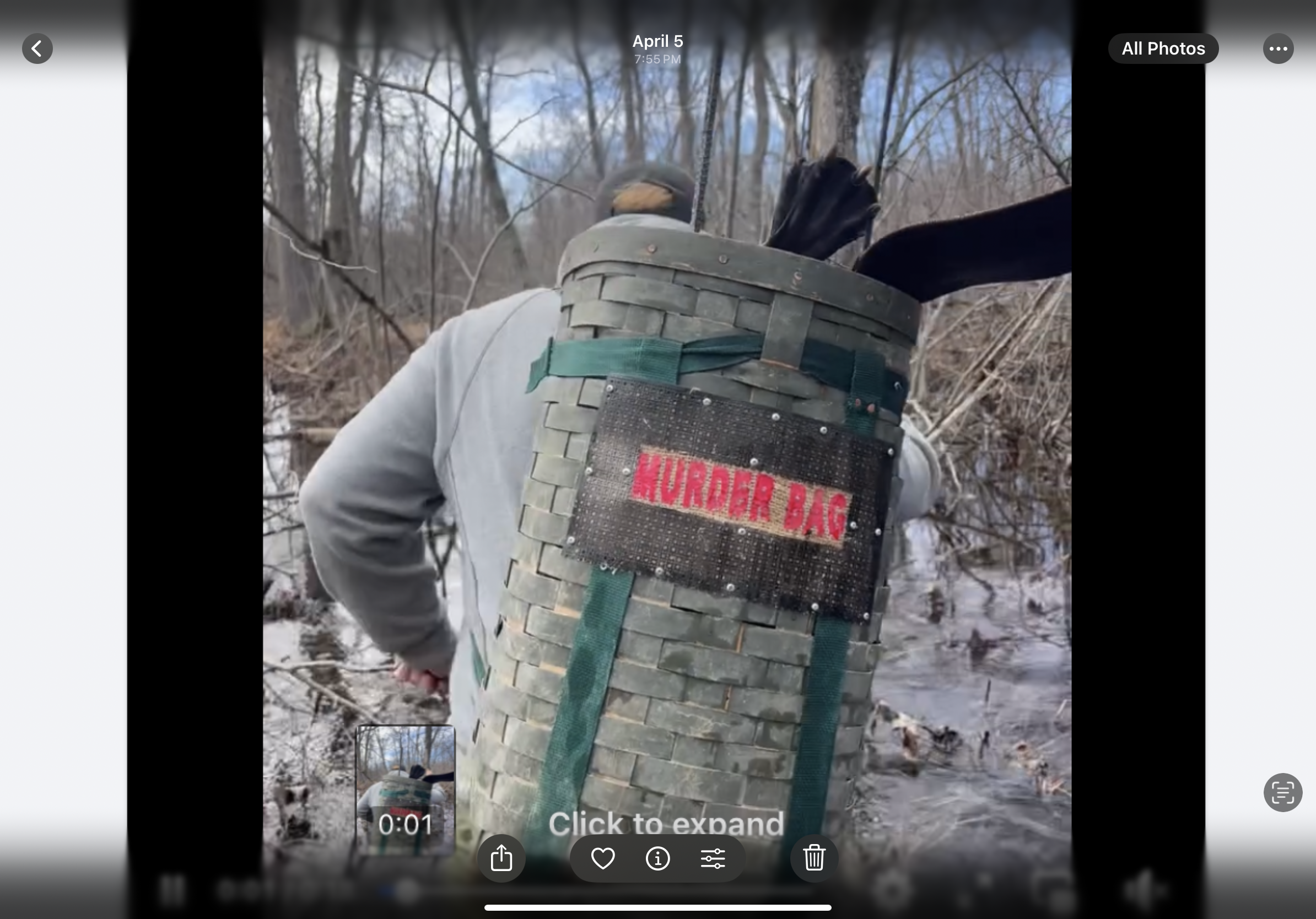
Screenshot showing a trapper carrying a basket labelled “Murder Bag” through a wooded wetland. Source: Trapper’s social media footage.
The various trapping associations and groups are very deliberate with their messaging and often caution individual trappers to be careful about what they post on social media. The picture above suggests that not all heed their advice and instead, proudly portray their callousness and lack of respect for all to see.
A prime example of careful messaging can be found on The Trapping Classroom’s Facebook page that warns members about what posts and pictures are acceptable as it states:
“. . . any posts that do not show respect to the animal will also be deleted. For example, a photo showing tons of foot damage. We all know things happen in trapping but we need to do our part to respect the animal and make sure such images aren’t used against trapping. We also do not want to see any posts about bashing anti’s or the message exchange about how you are going to go kill 10 animals in their name.”
Doing their part to ‘respect the animal’ seems much more like an effort to cover up what’s really happening to trapped animals rather than anything remotely related to respect or animal welfare.
Tom Miranda, a well-known trophy hunter and trapper and member of the United States National Trappers Association (USNTA), recently recorded a video message to the US trapping community imploring trappers to become USNTA members and spoke about careful messaging. “Trapping is under a lot of scrutiny from a lot of people,” explained Miranda. “This is a war we’re fighting here and we need an army of trappers to get it done.” His message focused on increasing recruitment in order to build a larger community to push back against those who are opposed to trapping. Using a military metaphor, he declared, “Yeah, a six-man seal team can get it done, but not against thousands, and thousands, and thousands of anti’s. You need the whole army in there to get it done.”
Miranda gushed about trappers and the trapping industry being the liberators of wildlife in the United States as he laid the propaganda on thick:
“We have the best hunting, fishing and trapping in the world because we have conservation - wise use of natural resources. The worst thing that can happen is we can outlaw trapping and preservation takes over. Preservation doesn’t preserve anything. These animals will go down. The populations will decrease. Trapping is conservation. Trapping keeps animals around.”
His enthusiastic rant continued, but took a bit of a strange twist while he further amped up the propaganda, “That’s what people don’t understand,” continued Miranda. “How can someone love an animal so much, yet kill it. Now it’s not a real good day for the animal you catch, but all the other animals that live in the forest, it’s a real good day because it’s conservation. They’re either going to die of disease or they’re going to get run over by a car, or something else is going to happen to them.”

Screenshot of Tom Miranda discussing trapping's role in wildlife conservation in a video posted to the National Trappers Association's platform.
To show just how much he loves these animals, Miranda pays tribute to hundreds of them by posing for pictures with their lifeless bodies after having killed them. Immediately after declaring his undying love (pun intended), he awkwardly segued to speak about the monetary benefits. “Also, hunting and trapping gives wildlife value. It happens in Africa all the time. Why poach an elephant if it’s worth way more money for a hunter to come over and hunt it. So that’s what conservation needs and is.”
Miranda, in this brief video, synthesized what many in the commercial fur trapping industry describe with regard to how they feel about the wildlife they trap and kill. They use words such as love, compassion and respect, but in reality, wildlife is reduced to a mere commodity where their value as living beings is directly related to the value of their pelts or their worth as a trophy.
Miranda concluded his address with an appeal to US trappers to join the USNTA stating, “Please take my pleading and take my advice to join the National Trapper’s Association. It’ll be the best thing you can do for the sport, it’ll be the best thing you can do for the animals, it’ll be the best thing you can do for trappers. Don’t be a taker, be a giver with the National Trapper’s Association.”
The irony of that last sentence cannot be overstated and to refer to commercial trapping as a sport speaks volumes about his mindset regarding the animals he kills. Does that comport with the idea of commercial fur trapping being a viable way to earn money, or is it more likely that trappers trap because they simply enjoy it? The numerous pictures and videos online of trappers smiling broadly while posing with terrified animals caught in restraining traps and dead animals caught in killing traps, answers that question.
PREDATORS BAD - TRAPPERS GOOD
Trappers and hunters often vilify predator species to justify killing them on a grand scale. “Smoke a pack a day,” is a popular slogan used by trappers and hunters promoting the slaughtering of wolves. “The only good coyote is a dead coyote,” is another. Pictures of dead coyotes filling truck beds abound on trappers’ social media pages. “Fawn killers,” is still another popular refrain used to malign predators and justify large-scale predator trapping. These attitudes towards predators have no place in any conversation about conservation and clearly demonstrates a bias based on loathing and hostility towards these animals. Proulx concurs as he states, . . . “trappers like to dramatize and exaggerate. Predators rarely cause the extirpation of a population. Large predators take their share of big game and this upsets the hunters and trappers. But trappers are not the Marvel saviours of the world.”
If compassionate conservation was truly the goal, then why would the Alberta Trappers Association, in the winter of 2024, sponsor a wolf-killing contest? Under the guise of calling it the Alberta Ungulates Enhancement Project, the association pays a bounty for dead wolves where first prize brings in $5000, second prize gets $2500 and coming in third pays out $1000. Every subsequent dead wolf carcass brings the killers $250 per wolf with no limits on how many can be trapped and killed province wide. According to Kim Odland, Exposed Wildlife Conservancy Co-Founder:
“The Alberta Ungulate Enhancement Program is not based on science, wildlife biology or ethics. It’s an excuse for trappers to kill as many wolves as they can this winter, under the false premise that killing wolves enhances ungulate populations, presumably so that hunters have more elk, moose and deer to kill. The argument that trapping is a necessary tool for wildlife management like this is not supported by current science and wildlife killing contests like this are abhorred in modern society.”
Killing contests not only fly in the face of true conservation, it turns trapping into a blood sport where trappers are motivated by the prospect of a monetary windfall rather than any vague notion of wildlife stewardship.
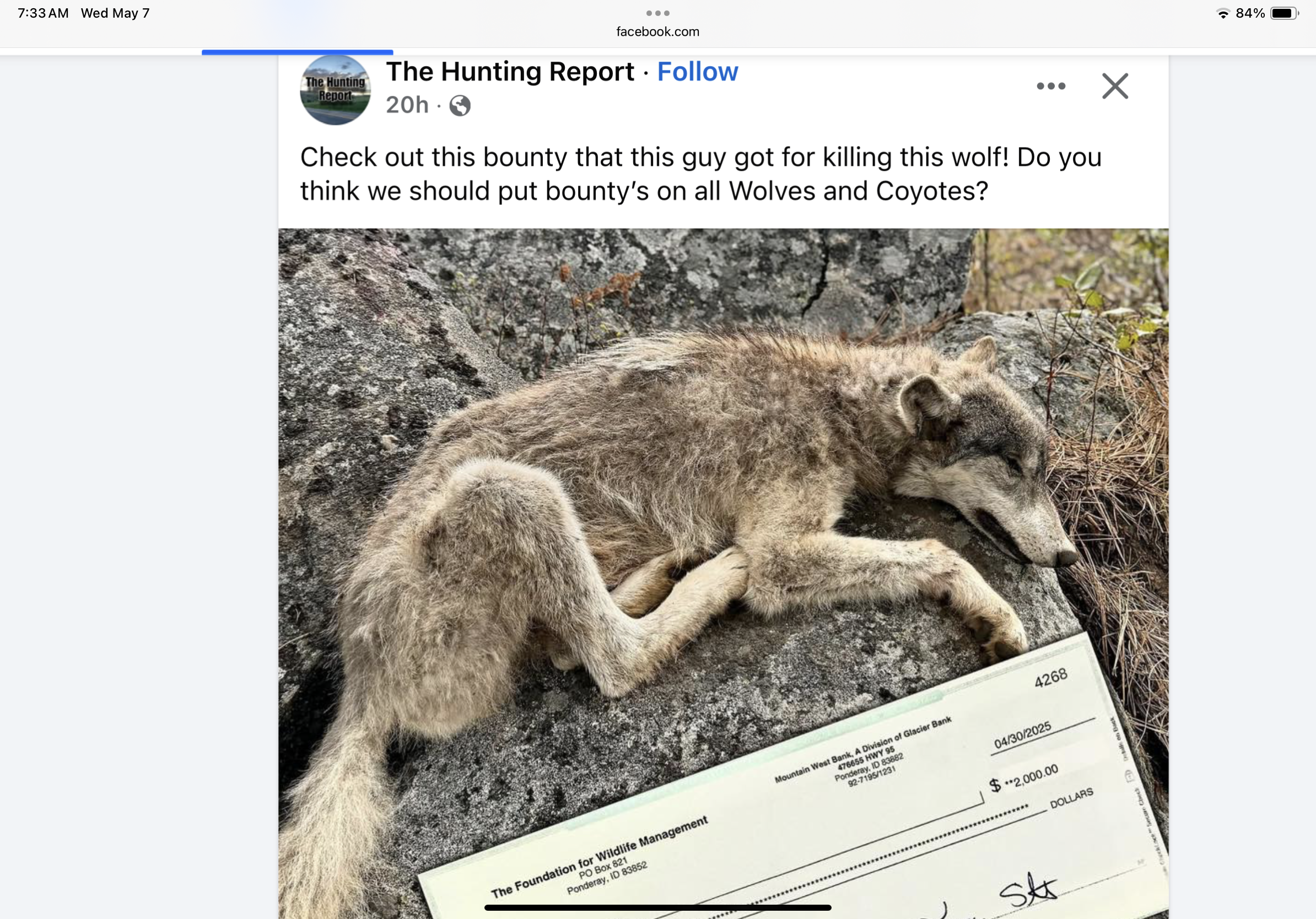
Screenshot of a Facebook post by The Hunting Report showing a dead wolf alongside an apparent $2,000 payment from the Foundation for Wildlife Management. The post raises the question of expanding predator bounties.
What the science does reveal as evidenced in a paper co-written by Proulx and Kim Villeneuve entitled, Ecological Advantages of Grey Wolf (canis lupis) Reintroductions and Recolonizations in North America, is how “. . . some carnivores such as wolves play a very important role in their ecosystem, and their removal can lead to ecological catastrophes.” The authors concluded that, “recent studies tend to suggest that wolf reintroductions and recolononizations have a beneficial impact on the conservation of diversified wildlife communities, with multiple interactions between carnivores and scavengers, carnivores and herbivores, and herbivores and vegetation.”
RESISTANCE TO INNOVATION
If reducing animal suffering is an important consideration and a high priority for the commercial fur trapping industry, as they claim it is, then wouldn’t they fully embrace research into more humane trapping methods and endorse the use of traps designed to reduce animal suffering? Not so, according Proulx, who has spent decades researching new and innovative ways to make trapping a more humane practice.
“Commercial trapping has been, and will remain, an issue because trapper associations do not listen to what we have said in the last 50 plus years. The trappers are still using inhumane trapping systems, and animals are injured and in pain. The best example is the use of killing neck snares that have been found inhumane and non-selective.”
If fur trappers’ associations are sincere in their assertions that they are compassionate and truly care about the wildlife they trap, then why the resistance to change? Why not evolve if it means less animal suffering? Proulx thinks this lack of willingness to adopt humane trapping guidelines and methods stems more from being answerable to agencies less concerned with animal welfare than they are with commerce:
“. . . We developed alternatives to antiquated traps, and we developed protocols to further improve them. However, the actual trapping standards have been developed under the supervision of trade ministries and they do not represent state-of-the-art technology. I published a paper on this subject (Mammal Trapping - chapter 17) and I also developed new standards with researchers from around the world – these standards have been adopted by some scientists. However, the fur industry will not look at them.”
‘HUMANE’ TRAPPING - A PARADOX
If suffering and death are inextricably linked to commercial trapping, does the term ‘humane’ belong anywhere in the conversation. Reducing the amount of time in between checking traps, making traps less injurious, and decreasing the time to irreversible unconsciousness are all worthwhile pursuits if commercial fur trapping is to continue. But even if these innovations lead to a lesser amount of suffering, can trapping ever really be considered humane? The act of setting a trap that will cause an animal to suffer and die, regardless of the amount of time it takes, or the extent of injuries the trap may cause, does not meet the definition of what it is to be humane. The term ‘humane’ is defined as having compassion and sympathy for people and animals, including those who are in pain or suffering. It seems a stretch to conclude that commercial fur trapping can meet that definition when it is the source of the animal’s suffering.
To summarize then, if commercial trapping is cruel, inhumane, and causes intolerable suffering and if the commercial fur trapping industry is loathed to adopt innovative ways to reduce animal suffering and if the demand for furs is dwindling worldwide, is it time to consider ending commercial trapping in Canada altogether? “If fur trapping was to stop tomorrow, no catastrophe would happen,” writes Proulx. “Our cities would not be invaded by wolves and wolverines, or other ‘dangerous’ fur bearers. After all, there are cities where trapping is not permitted in their vicinity.” But, Proulx still endorses fur trapping in some instances stating, “Fur bearer trapping is important for northern Indigenous communities who need furs (and money associated with their sale) and food for subsistence.”
Those who are against commercial fur trapping, by and large, are not ‘radical anti’s’ as trappers like to say. The irony of the commercial trapping community portraying themselves as compassionate conservationists while branding people opposed to commercial fur trapping as fanatical, is not lost on me. To want to protect wildlife from prolonged suffering and death hardly seems extreme. However, knowingly and eagerly inflicting pain and misery upon other beings, certainly does. From my own perspective, I understand that part of wildlife management may require human intervention in cases of disease, conflict, overpopulation, etc., but to offload that responsibility to a commercial industry whose sole purpose is to profit from fur sales, makes about as much sense as putting a guide outfitter in charge of the wildlife management portfolio as is actually the case in Alberta.
One of the fundamental differences between those who are for commercial trapping and those against it, is in the argument itself. The trapping community often resorts to disparaging those who speak out against fur trapping, as evidenced from my brief communication with Abercrombie, rather than presenting evidence to back up their claims that fur trapping is humane and does not cause prolonged suffering. However, there is no shortage of video evidence showing how cruel and inhumane commercial trapping really is. There is no need to get drawn into a back and forth of personal attacks as the evidence speaks for itself.
Commercial trapping is happening all around us in Canada, which means numerous wildlife species continue to endure senseless pain and suffering to satisfy an outdated and cruel commercial fur industry that does not benefit society in any tangible way. The only exception, as Proulx points out, is the northern indigenous communities where fur trapping is essential for subsistence as well as income. When it comes to stakeholder interests in nature and wildlife, governments tend to favour the trapping and hunting communities as they both have powerful lobby groups that hold significant sway over politicians. However, a much larger segment of the Canadian population does not participate in either activity and their interests in Canada’s natural environment are largely ignored. Most people are against commercial fur trapping, but are unaware of the scale at which it is still happening. In order to bring about change, people need to be made aware that fur trapping continues to be widespread and that thousands of animals are trapped and killed annually with archaic and cruel trapping methods. For change to happen, people must voice their opposition to commercial fur trapping and demand that the Canadian and provincial governments enact much stricter regulations to protect wildlife from the intolerable suffering they continue to endure.
In the past, fur trapping was a viable way to make a living, albeit one that inflicted unspeakable suffering upon wildlife species. Today, with the steep reduction in demand for furs worldwide, trapping is no longer a feasible way to earn a living wage. Yet, trappers still cling to this cruel practice claiming to be wildlife stewards and integral to wildlife management. What is so alluring about venturing into the wilderness to trap and kill wildlife? So many trappers talk about their love for the outdoors and how fur trapping is more a lifestyle than a way to make a living. Is it not possible to enjoy the natural environment without killing its occupants? It’s hard to imagine how the act of taking an animal’s life can bring so much satisfaction to those who take up this practice.
To be clear, this article is strictly about commercial fur trapping and whether or not it should continue given its inherent cruelty and loss of relevance largely due to growing public disdain for the fur trade. As mentioned earlier, some forms of trapping may be necessary to mitigate conflicts with humans, to control disease outbreaks, and in some instances of pest control. But rather than delegating those tasks to commercial fur trappers with little to no oversight, should it not be under the strict supervision of wildlife management professionals? “I think that trapping still plays a role in scientific research,” explains Proulx, “but in most cases, it can be replaced with non-invasive methods such as camera traps, scat collection and analyses, DNA sampling (hair, saliva, scats, urine, blood). Sometimes, we must deal with a disease outbreak – e.g., rabies, distemper, hantavirus, and so on. In these cases, it is nice to have access to trappers to help remove the animals.”
Commercial fur trappers tend to think of wildlife in terms of numbers rather than individual animals with feelings and emotions. Ignoring the reality that they experience fear, pain, sadness, joy and anger in much the same way humans do, makes it much easier to end their lives. If you are only concerned about what wildlife populations can sustain in terms of harvesting, then you are deliberately ignoring them as individuals, with distinct personalities and characteristics who are experiencing what it means to be alive, in much the same way that we do.
“The question is not can they reason, nor can they talk? But can they suffer?” - Jeremy Bentham.
Originally published April 25, 2025, in Wild & Woke on Substack. Republished on THIS — Trophy Hunting Is Stupid.